


AI Video Tools – Next-Gen Video Editing Software
- AI Tools directory
- October 9, 2025
- No Comments
AI video tools or AI video editing software are transforming how content creators, marketers, and educators produce engaging visual content. These sophisticated tools harness artificial intelligence to streamline video editing, enhance creativity, and reduce production costs.
As these technologies mature, they are redefining the standards of video creation, making high-quality content accessible to all. This article delves into every aspect of these AI innovations, offering insights into their capabilities, applications, and the exciting future ahead.
The Rise of AI Video Tools: A Comprehensive Overview
Artificial Intelligence has surged into the multimedia industry, fundamentally altering traditional video production. Over the past few years, AI video tools have evolved from basic automation scripts to intelligent platforms capable of designing, editing, and customizing high-quality videos with minimal human intervention. This surge is driven by AI video tools advances in machine learning, computer vision, deep neural networks, and natural language processing, which collectively empower these tools to understand content context and generate realistic visuals.
These tools support a democratization phenomenon—allowing individuals and small businesses to produce professional-grade videos without large budgets or specialized skills. Instead of laborious editing processes, users can leverage AI-powered platforms to generate content faster and more creatively.
As the market expands, the competition among AI video tools companies like Runway, Synthesia, and Pika Labs has pushed innovation forward, leading to intuitive interfaces, improved output quality, and versatile applications spanning marketing, education, entertainment, and more. The rise of AI video tools marks a pivotal moment in digital content creation, where efficiency meets creativity in unprecedented ways.
Runway ML: Exploring the Capabilities and Applications
Runway ML has established itself as a cornerstone in AI video editing software, bringing machine learning directly into the creative workflow. Its platform is designed for users of varying skill levels—from novice creators to seasoned professionals—offering an extensive suite of tools that simplify complex video editing processes. One of its most compelling features is the ability to perform real-time video synthesis, style transfer, and object removal, all driven by user-friendly interfaces.
Beyond basic editing, Runway ML enables innovative artistic expression through its generative models. Creators can generate realistic backgrounds, animate characters, or modify existing footage with minimal effort. Its applications stretch across diverse fields: filmmakers can prototype scenes rapidly, marketers can craft ad videos effortlessly, and educators can develop engaging visual content for lessons. Runway’s flexibility exemplifies how AI directory tools are not just augmenting editing but revolutionizing entire creative processes, lowering barriers to high-quality video production.
Synthesia: Revolutionizing Video Creation with AI Avatars
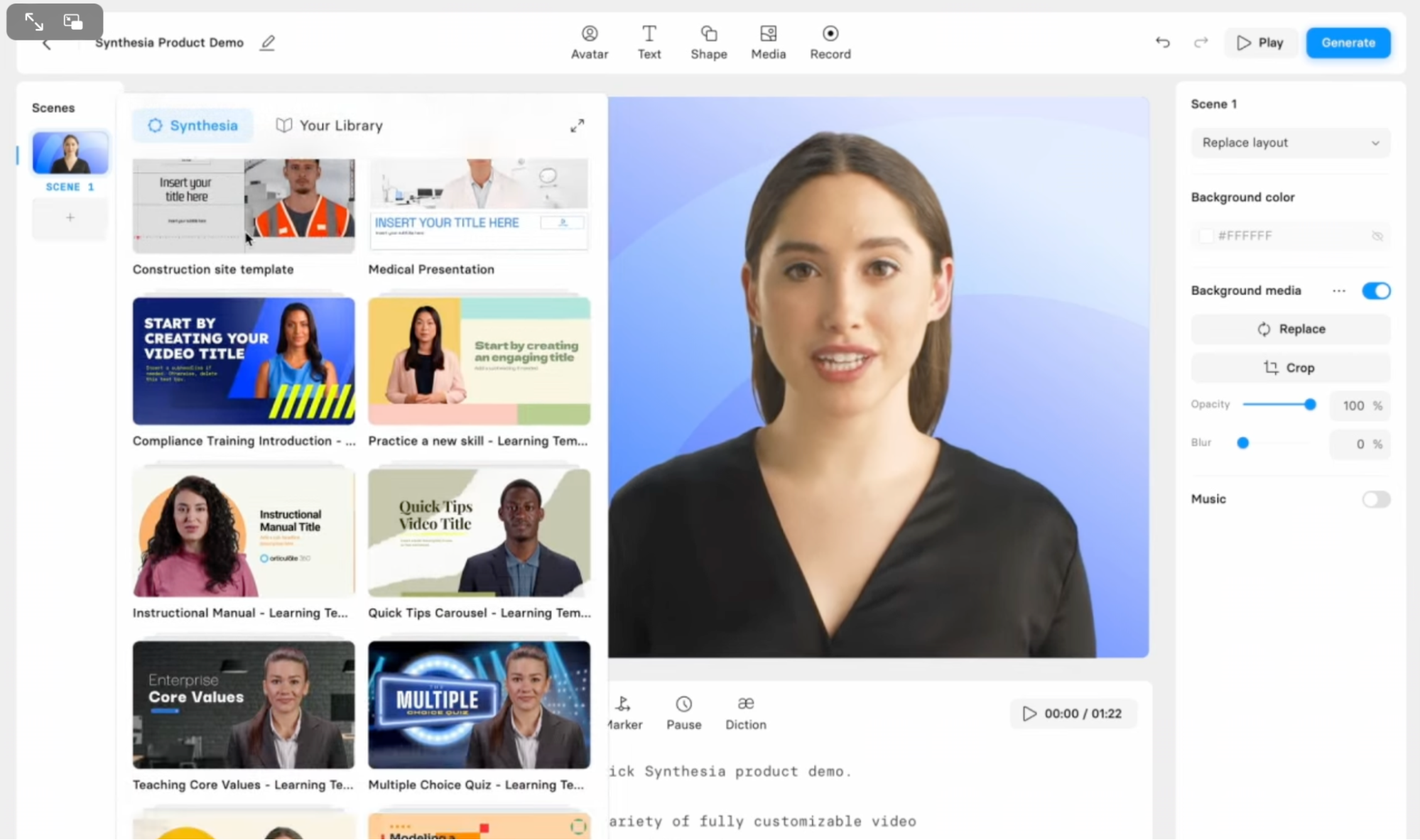
Synthesia stands out as a pioneering platform in the realm of AI-powered video creation, especially known for its realistic AI avatars. Its core innovation lies in transforming plain text into engaging video content by generating virtual presenters capable of speaking multiple languages fluently. This capability drastically reduces the need for physical actors or in-studio recordings, making video production more accessible and cost-effective.
The platform’s applications are extensive: corporate training videos, marketing campaigns, personalized messages, and more. Synthesia’s AI avatars are not just static images; they are adaptive, expressive personalities capable of conveying emotions and nuances, thereby enhancing viewer engagement. This technology democratizes video creation, allowing small teams and individual entrepreneurs to produce professional videos without extensive multimedia expertise. Synthesia exemplifies how AI avatars are redefining how we think about visual narratives, offering a future where personalized and scalable video content is readily available.
Pika Labs: A Deep Dive into AI-Powered Video Generation
Pika Labs has garnered attention as a potent tool for generating animated videos using AI. Its technology focuses on transforming simple prompts into lively, expressive animations that can serve marketing, storytelling, or educational purposes. Unlike traditional video editing, Pika Labs emphasizes creative control over AI-generated assets, empowering users to customize styles, characters, and motions with ease.
Its unique proposition is to facilitate rapid iteration—allowing creators to experiment with visuals and narratives without the lengthy production cycles typical in conventional filmmaking. For content creators and brands, this means faster turnaround times and more dynamic content tailored to specific audiences. Pika Labs exemplifies how AI-powered video generation is shifting the creative paradigm—enabling not just editing but full-scale content creation driven by intuitive AI systems that support storytelling in an innovative and engaging way.
AI Video Editing Software: Transforming the Creative Landscape
The advent of AI video editing software has reshaped the fundamentals of content creation, fostering efficiency, accuracy, and limitless creativity. Traditional editing required meticulous manual work—cutting clips, syncing audio, color grading, and more. Now, AI video tools automates many of these tasks, from scene detection and auto-cropping to intelligent color correction and even predictive editing suggestions. This augmentation allows creators to focus more on conceptualization rather than technical manual labor.
Additionally, these tools offer new creative possibilities—such as AI-driven scene synthesis, real-time visual enhancements, and deepfake generation—making it possible to craft complex narratives effortlessly. As AI video tools continues to evolve, these platforms will likely integrate more immersive features like virtual reality or augmented reality editing.
Overall, AI video editing software is democratizing video production, giving rise to a new era where quality, speed, and innovation are no longer mutually exclusive, and creators are empowered to produce compelling content at an unprecedented scale.
Runway vs. Synthesia vs. Pika Labs: A Comparative Analysis
When evaluating AI video tools, understanding their individual strengths and ideal use cases is crucial. Runway ML excels in versatility and advanced editing features—ideal for professionals seeking detailed control over video manipulation and special effects. Its deep integration with machine learning models facilitates innovative workflows, making it suitable for high-end production environments.
Synthesia, on the other hand, focuses on personalized video creation through realistic AI avatars. Its strengths lie in scalable, quick content generation that doesn’t require actors or recording logistics. It’s perfect for corporate communication, e-learning, and marketing where personalized, scalable videos are needed. Pika Labs distinguishes itself in creative animation and storytelling, providing tools for rapid, AI-driven animated content. Its emphasis on interactivity makes it suitable for engaging marketing campaigns and educational animations.
Ultimately, choosing between these platforms depends on project goals: whether you need detailed editing (Runway), avatar-based videos (Synthesia), or animated storytelling (Pika Labs). Each complements different aspects of the modern video production landscape, showcasing the diversity and potential of AI-driven video creation.
The Impact of AI Video Tools on Content Creation Industries
AI video tools have fundamentally shifted how industries approach content creation. Marketing agencies now produce customizable video ads at a fraction of traditional costs, enabling more targeted and frequent campaigns. Educational institutions leverage these tools to develop engaging, personalized learning content that keeps students captivated, especially in virtual environments. The entertainment industry, too, has explored AI for generating visual effects or even entire scenes, significantly impacting production pipelines.
Beyond financial and workflow efficiencies, AI-driven video creation fosters democratization—empowering individuals and small organizations to compete with larger studios. Creators can experiment more freely, taking creative risks that were previously prohibitively expensive or complex. However, this shift also introduces challenges—such as copyright concerns, authenticity issues, and the need for ethical guidelines—highlighting the importance of responsible adoption.
As AI video tools become central to content industries, they will continue redefining workflows, ethical standards, and creative boundaries.
Future Trends in AI Video Editing Software and Generation
Looking ahead, AI video tools will become more integrated, intuitive, and immersive. We can anticipate advancements in real-time editing, allowing creators to modify videos on-the-fly during live production. Virtual and augmented reality integrations are expected to become mainstream, enabling hyper-realistic virtual environments created instantly by AI.
The next horizon involves generative AI video tools models capable of producing entire films or series from simple prompts, blurring the lines between creator and AI collaborator.
Furthermore, personalization will reach new heights—AI will tailor content not only to target audiences but to individual viewer preferences, creating hyper-customized experiences. Ethical safeguards and intellectual property protections will evolve alongside these capabilities, addressing concerns over deepfakes and authenticity. Ultimately, AI video tools creation promises to democratize high-end production, spark new forms of storytelling, and push the boundaries of human creativity while necessitating thoughtful governance.
Ethical Considerations and Challenges in AI-Generated Video
As AI-powered video tools become more sophisticated, ethical considerations grow increasingly complex. Deepfake technology and realistic avatars pose risks of misinformation, identity theft, and malicious manipulation, demanding stringent regulation and transparency. Content creators and platforms must navigate the fine line between innovation and unethical use, striving to maintain trust and authenticity in digital media.
Another challenge lies in intellectual property rights—the question of who owns AI-generated content and how credit is assigned remains unresolved. Moreover, biases embedded in training data can lead to stereotypical representations or unfair portrayals, necessitating ongoing attention to diversity and fairness. As AI video tools continue their rapid growth, developing ethical standards and transparency practices is essential for fostering responsible innovation and protecting public trust.
Best Practices for Utilizing AI Video Tools Effectively
To maximize the benefits of AI video tools, creators should adopt strategic workflows that combine human creativity with AI efficiency. It’s vital to have clear content goals and understand the capabilities and limitations of each platform—whether emphasizing detailed editing (Runway), avatar-based communication (Synthesia), or animated storytelling (Pika Labs). Regularly updating skills and staying informed about emerging features ensures the full potential of these tools can be harnessed authentically.
Furthermore, maintaining ethical standards—such as disclosing AI involvement and avoiding deceptive manipulations—is paramount. Combining AI-generated content with manual refinement often yields the most professional results, striking a balance between automation and artistic control. Lastly, fostering a collaborative environment where AI tools serve as creative allies rather than replacements enables a more innovative, responsible, and sustainable approach to modern content creation.
Relevant Reads:
AI Tools Directory: Guide to Top Artificial Intelligence Solutions
AI Image Generators – The Future of Creative Expression
Conclusion
AI video tools|Runway|Synthesia|Pika Labs|AI video editing software are revolutionizing how we create, share, and experience visual content. From democratizing high-quality video production and enabling fast-paced marketing campaigns to redefining storytelling and artistic expression, these technologies are fundamentally transforming the creative landscape. While offering immense opportunities, they also challenge traditional notions of authenticity and ownership, underscoring the need for responsible usage.
As advancements continue, we can expect even more sophisticated, immersive, and personalized video experiences. We suggest to List your AI tool on TheAISurf that empower creators and industries alike, heralding a new era of innovation and storytelling.