


AI Summarization Tools — AI Text Summarizer Revolution
- AI Tools directory
- October 12, 2025
- No Comments
The deluge of information can be overwhelming for researchers, students, and professionals alike. Enter AI summarization tools, AI text summarizer, innovative solutions that leverage artificial intelligence to distill lengthy documents into concise, digestible summaries. These tools are transforming how we consume and analyze data, enabling users to save time, enhance productivity, and make informed decisions swiftly.
As the demand for efficient content management grows, understanding the capabilities, strengths, and limitations of these AI-driven summarizers becomes essential for unlocking their full potential. Discover the power of cutting-edge AI summarization tools on a leading AI tools platform, making text summarization faster, smarter, and more efficient than ever.
AI Summarization Tools: A Comprehensive Overview

AI summarization tools have evolved significantly from their initial conception, shifting from simple extraction algorithms to sophisticated systems employing deep learning and natural language processing (NLP). These AI summarization tools are designed to analyze textual content, identify the most relevant information, and generate summaries that preserve the core message.
Today, they serve a broad spectrum of applications, including academic research, legal analysis, content curation, and more. This comprehensive overview explores the technological foundation, types, and practical significance of these tools, emphasizing how they streamline chunking large volumes of information into manageable insights.
At their core, AI summarization tools harness NLP techniques such as semantic analysis, context understanding, and machine learning models trained on extensive datasets. The two primary types—extractive and abstractive summarization—offer distinct approaches. Extractive methods select key sentences or phrases directly from the original text, providing a straightforward snapshot.
Abstractive techniques, however, generate paraphrased, human-like summaries, often resulting in more coherent and natural outputs. As advancements continue, hybrid models combining these approaches are becoming increasingly prevalent, further enhancing the quality and utility of AI summaries.
Scholarcy vs. Upword: A Comparative Analysis of AI Summarizers
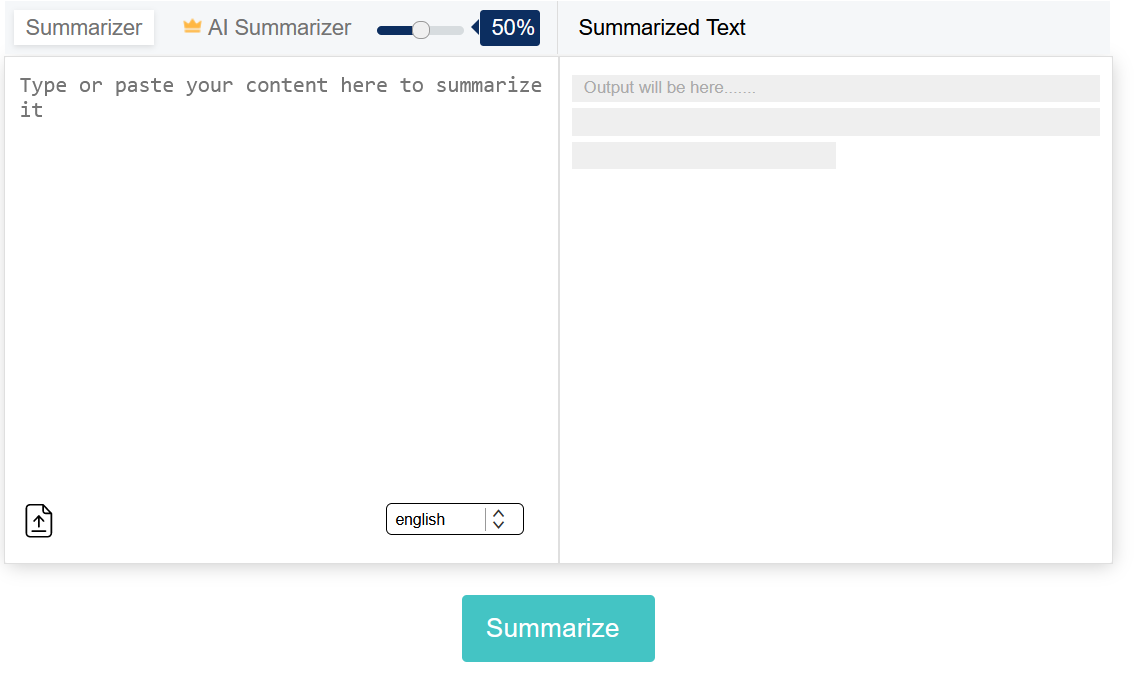
When comparing Scholarcy and Upword, both represent leading solutions within the AI summarization ecosystem, yet they are optimized for different user needs and contexts. Scholarcy emphasizes academic and research-intensive applications, utilizing advanced algorithms to digest lengthy papers, reports, and reference texts. It excels in extracting key points, generating flashcards, and synthesizing complex information into digestible parts, making it a favorite among researchers and students seeking quick comprehension of scholarly material.
Upword, on the other hand, is designed with versatility and user engagement in mind. It appeals to business professionals, content creators, and general users who need fast summaries of articles, documents, or online content. Upword’s interface emphasizes ease of use, integration with browsing tools, and real-time summary generation. While both AI summarization tools harness AI text summarizer capabilities, Scholarcy is more research-centric with a focus on academic rigor, whereas Upword prioritizes speed, simplicity, and broad usability for diverse content types.
Leveraging AI Text Summarizers for Enhanced Productivity
Incorporating AI text summarizers into daily workflows can dramatically boost productivity across various fields. For researchers, these tools cut down hours of reading by offering concise abstracts, allowing them to prioritize which papers to explore further. Students benefit from quick comprehension of textbooks and research articles, freeing up time for critical analysis and synthesis. Professionals in business or law can distill lengthy reports and legal documents into precise summaries, facilitating faster decision-making processes.
Beyond individual use, organizations can embed AI summarization into their content management systems, automating report generation and summarizing client feedback or market trends. The ability of AI to process vast datasets or document repositories ensures that valuable insights are never overlooked due to sheer volume. Nevertheless, users should balance automation with human oversight to maintain accuracy and context sensitivity, especially when dealing with nuanced or sensitive information.
Discover the Best AI Directory to find powerful AI text summarizers that boost productivity and streamline your workflow.
Upword: A Deep Dive into its Features and Benefits
Upword stands out among AI summarizers for its intuitive design and real-time capabilities, making it particularly appealing to users seeking quick, reliable outputs. Its core features include browser extensions that enable instant summaries of online articles and content, as well as integrations with popular productivity applications. The AI summarization tools employs advanced NLP algorithms to generate concise summaries, key takeaways, and even highlight crucial data points without sacrificing context.
The benefits of Upword extend beyond mere summaries; it helps users retain information better by focusing on the most impactful parts of a text. Its user-friendly interface minimizes the learning curve, promoting widespread adoption among non-technical users. Moreover, Upword supports customization—allowing users to specify summary lengths or focus areas—making it adaptable for various needs. This flexibility exemplifies how innovative AI text summarizer tools are becoming indispensable for productivity enhancement in diverse scenarios.
Scholarcy: Unlocking the Power of AI-Driven Research Summarization
Scholarcy is a pioneer in the realm of AI-driven research summarization, tailored primarily for academic and scientific communities. Its ability to process complex research papers, extracting critical data, references, and insights, has made it invaluable for scholars handling extensive literature reviews. Scholarcy’s advanced algorithms analyze the structure of scientific articles, providing summaries that include highlights of methodology, key findings, and implications, enriching the research process beyond simple abstract paraphrasing.
One of Scholarcy’s standout features is its ability to generate flashcards and knowledge graphs, transforming static summaries into interactive learning tools. These functionalities facilitate better comprehension, retention, and cross-referencing among researchers. As AI text summarizer tools evolve, Scholarcy continues to push boundaries by integrating with reference managers, Zotero, and Mendeley, streamlining academic workflows. Its impact underscores how AI can revolutionize research efficiency, enabling scholars to navigate vast scholarly landscapes with unprecedented speed and clarity.
The Evolution of AI Text Summarization: From Basic Algorithms to Advanced Tools
The history of AI text summarization narrates an impressive evolution from rudimentary keyword extraction to sophisticated language understanding models. Early algorithms relied heavily on simple statistical techniques, such as term frequency and positional weighting, which often resulted in disjointed or contextually inconsistent summaries. These initial AI summarization tools served as proof of concept but lacked nuance and flexibility, especially with complex or lengthy texts.
Today, the advent of deep learning, transformer architectures like GPT, BERT, and other neural networks has revolutionized the field. These models employ extensive pretraining on massive datasets, enabling them to understand context, idiomatic expressions, and subtle nuances in language. Explore the evolution of AI text summarization and discover top tools featured in the Best AI Directory for smarter, faster content processing.
As a result, current AI text summarizer tools can produce human-like summaries, capturing essence while maintaining coherence. The ongoing innovation suggests a future where AI-generated summaries will become even more accurate, context-aware, and seamlessly integrated into our daily information consumption habits.
Choosing the Right AI Summarizer: A Guide for Researchers and Professionals
Selecting the optimal AI text summarizer depends on several factors, including the nature of content, required precision, and user expertise. Researchers dealing with technical papers and complex datasets may prioritize tools like Scholarcy, which excel in extracting detailed insights and managing references. Conversely, business professionals or content marketers seeking quick content overviews might prefer Upword for its fast turnaround and user-friendly interface.
Additionally, considerations such as integration capabilities with existing workflows, customization features, and accessibility should influence the choice. Assessing the AI summarization tool’s accuracy, adaptability, and support for diverse formats is critical to ensure it meets specific needs. Ultimately, trialing multiple AI summarization tools and aligning their functionalities with your goals can help you identify the most effective solution, thereby maximizing productivity and ensuring reliable outputs.
Improving Your Workflow with AI Summarization — Use Cases and Best Practices
Implementing AI summarization tools into your routine can dramatically improve efficiency, but it’s crucial to adopt best practices to maximize their benefits. For academic purposes, setting up automated workflows that incorporate Scholarcy for article analysis can save hours in literature review phases. For everyday content consumption, using browser extensions like Upword ensures rapid processing of online articles, enabling swift note-taking and research.
To optimize productivity, users should validate summaries against original texts, especially when critical decisions rely on nuanced information. Combining AI summaries with human judgment creates a balanced approach that leverages automation’s speed while maintaining accuracy.
Regularly updating tools and feedback cycles can improve the AI’s performance over time. These AI summarization tools strategies—from proper integration to quality control—allow users to harness AI summarization tools effectively, transforming information overload into actionable insights.
AI Summarization Tools: Accuracy, Limitations, and Ethical Considerations
Despite their impressive capabilities, AI summarization tools are not infallible. Accuracy can be affected by the quality of source material, complexity of language, and the sophistication of the underlying algorithms. Extractive methods may overlook nuanced meanings, while abstractive summaries risk introducing inaccuracies or misinterpretations if not properly supervised. Understanding these limitations is essential to avoid over-reliance and potential misinformation.
Ethical considerations also come into play, especially regarding intellectual property, bias, and transparency. AI AI summarization tools trained on biased data might inadvertently reinforce stereotypes or omit diverse perspectives. Additionally, users should be transparent about AI-generated content, particularly in academic or professional settings, to uphold integrity.
Responsible usage involves continuous validation, awareness of the technology’s boundaries, and adherence to ethical standards to ensure AI summarization truly adds value without unintended consequences. Boost your online presence and credibility by using our platform to claim your business on our AI Directory, ensuring your AI services are accurately represented.
The Future of Text Summarization — Exploring the Potential of AI
Looking ahead, AI text summarization is poised to become even more intelligent, context-aware, and conversational. With advancements in language understanding, future tools may offer personalized summaries based on user preferences, prior knowledge, or specific objectives. Interactive summaries that adapt in real-time, incorporate multimedia elements, or integrate with virtual assistants could redefine how we access information.
Moreover, as ethical frameworks and regulatory standards evolve, AI summarizers are expected to become more transparent and accountable, fostering trust among users. The integration of multimodal data—combining text, audio, and video summaries—will open new horizons for comprehensive content management.
Ultimately, AI-driven summarization will not only enhance productivity but reshape the very way humans engage with information, making knowledge acquisition more intuitive and accessible than ever before.
Relevant Reads:
AI Tools Directory: Guide to Top Artificial Intelligence Solutions
How AI Translation Tools or AI Localization Software Are Breaking Barriers
Conclusion
AI summarization tools, AI text summarizer have emerged as invaluable assets that transform how we process and comprehend vast quantities of content. By leveraging sophisticated NLP techniques, these AI summarization tools enable users to distill complex texts into concise insights, fostering productivity, better decision-making, and efficient research workflows.
Whether choosing Scholarcy for academic rigor or Upword for quick, versatile summaries, understanding their features, limitations, and ethical implications is crucial. As AI continues to advance, its role in shaping smarter, more agile information consumption will only grow, promising a future where knowledge is more accessible, manageable, and impactful than ever before.