


Best Chord AI Tools (2026): How Musicians Are Writing Smarter
- Music & Audio
- October 29, 2025
- No Comments
Two years ago, if you asked musicians about AI writing chords, most would laugh.
“Music is emotional. AI can’t feel.”
Fast-forward to 2026, and now?
Producers are using AI to generate chord progressions in seconds.
Songwriters are testing harmonic ideas faster than ever.
And beginners can finally write “good-sounding” music without theory knowledge.
But here’s the truth nobody talks about:
AI doesn’t replace creativity, it removes friction.
Today, musicians don’t start with theory, they start with ideas. And that’s exactly where the best chord AI tools 2026 shine.
I’ve watched producers, indie artists, YouTubers, and even complete beginners turn half-baked melodies into full songs using AI chord generators that feel more like collaborators than software.
This guide will show you the best chord AI tools, how they work, and how musicians are using them to write smarter, faster, and better.
The Rise of Chord AI in Music Creation
At its core, AI chord tools use machine learning and deep learning to understand harmony, rhythm, and emotional context.
Instead of guessing which chords might work, these tools analyze millions of musical patterns and suggest progressions that already feel right.
Think of them as a music theory AI assistant that never gets tired.
In 2026, the most advanced AI chord progression tools can:
- Generate chords from a melody, lyric, or mood
- Detect chords directly from audio files
- Output MIDI for instant DAW integration
- Adapt progressions by genre, tempo, or emotion
This is no longer experimental tech. It’s production-ready.
What Exactly Are AI Chord Tools?
AI chord tools are applications designed to generate, recognize, or assist with chord creation using artificial intelligence. You’ll see them referred to as:
- AI music chord generators
- Chord recognition AI
- Chord detection AI
- AI chord creation software
They work by analyzing harmonic relationships, chord prediction patterns, and stylistic rules, then applying that knowledge in real time.
Instead of manually building progressions, creators can now:
- Use text-to-chord AI prompts
- Convert audio into chords with audio to chord AI
- Export progressions via chord to MIDI AI converter
- Experiment with harmonic ideas instantly
That’s a massive shift in how music gets written.
Benefits of Using Chord AI Tools
Chord AI tools simplify songwriting by providing smart chord suggestions and real-time harmonization. They accelerate idea generation, bridge gaps in music theory knowledge, and enable faster composition.
Many also support collaboration and export to DAWs, helping musicians develop full songs from a simple melody or concept.
With AI’s learning capability, these tools continually adapt to user preferences, improving creativity and efficiency.
What creators love most:
- AI-powered chord suggestions based on mood or genre
- Real-time chord recognition AI for guitar and piano
- Chord progression automation for faster ideation
- Generative AI for music composition that still sounds human
How We Picked These Tools
- Accuracy of chord generation and recognition algorithms
- Quality of interface and workflow integration
- Collaboration and export features (MIDI, PDF, etc.)
- Affordability and flexible pricing options
- Compatibility across platforms (web, desktop, mobile)
- User feedback, stability, and innovation level
Top Tools (Ranked)
1. ChordChord
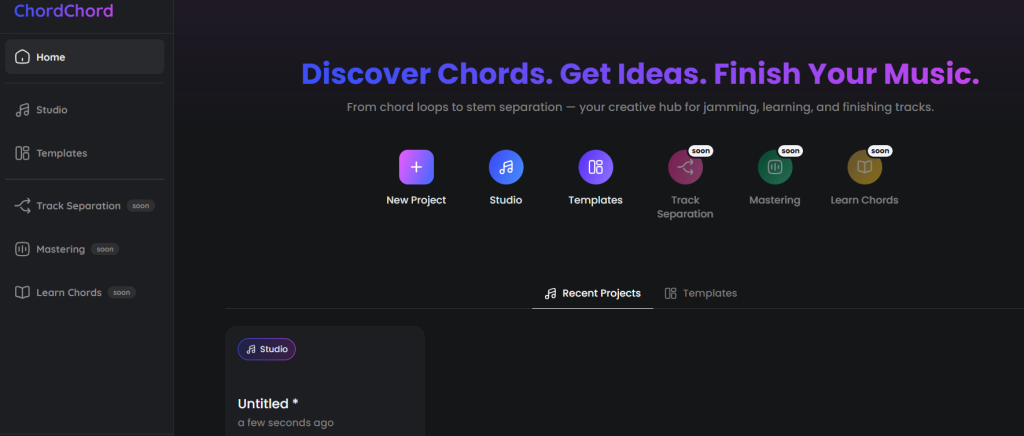
AI chord progression generator for seamless songwriting
What it is: ChordChord generates chord progressions based on musical style and emotion, helping users compose songs faster without deep theory knowledge.
Standout features:
- AI chord player with instant preview
- Style-based progression generator
- Educational plans for schools and institutions
- Collaboration options for students and creators
- Supports MIDI export and lyrics assistant
Pricing: See site for latest pricing
Best for: Musicians, songwriters, and educators
Pros: - Simple and intuitive interface
- Excellent for learning and experimentation
Cons: - Free version has limited exports
- Requires internet connection for saving projects
2. Chord Identifier
AI-powered chord recognition for any song or instrument
What it is: Chord Identifier automatically detects chords in uploaded audio and displays diagrams for multiple instruments.
Standout features:
- Unlimited audio chord recognition
- Auto-generated chord worksheets (PDF format)
- Support for guitar, piano, and other instruments
- Constant algorithm updates and improvements
Pricing: $4.99/month
Best for: Musicians analyzing songs or learning covers
Pros: - Accurate chord detection
- Affordable monthly plan with no ads
Cons: - Limited customization for advanced users
- Subscription required after trial period
3. ChordCreate
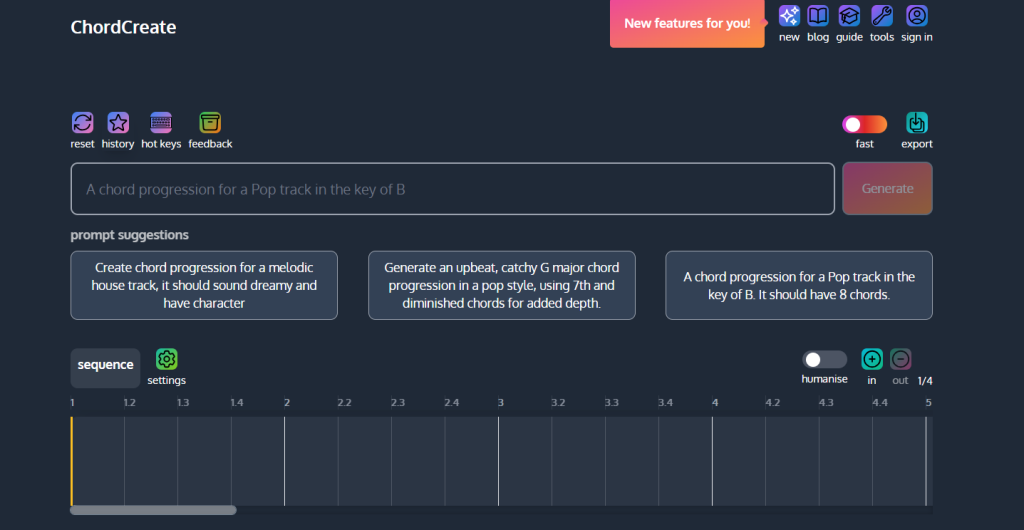
AI chord generator for effortless music creation
What it is: ChordCreate helps musicians design full chord progressions using AI suggestions tailored to genre and mood.
Standout features:
- Instant chord generation with one click
- AI-powered pattern matching
- One-day free access pass for testing
- No sign-up required for basic features
Pricing: Free Day Pass; see site for details
Best for: Beginner musicians and quick idea generation
Pros: - Fast and simple interface
- Great for creative experimentation
Cons: - Limited session duration in free plan
- No collaboration features
4. Lamucal
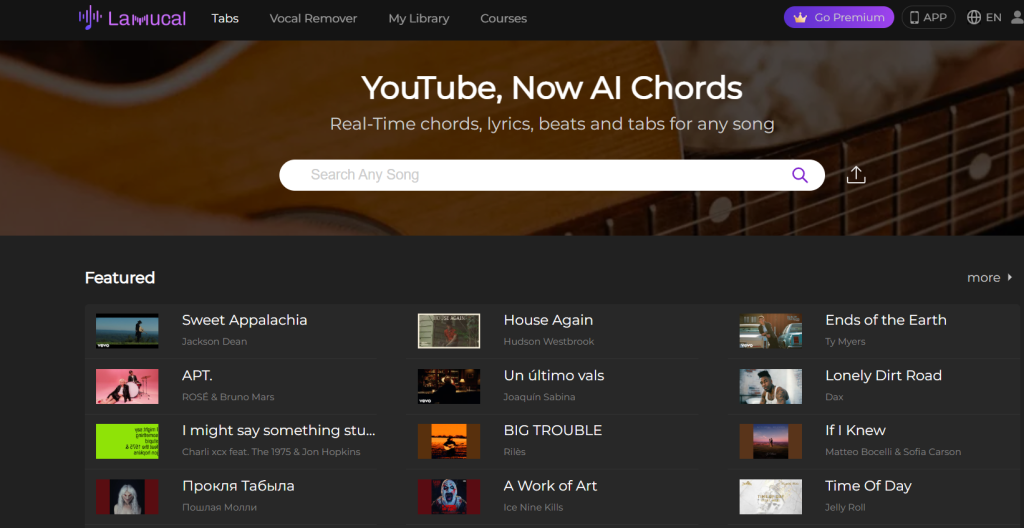
All-in-one AI platform for chords, covers, and vocal tools
What it is: Lamucal provides advanced AI tools for chord creation, song playback, and practice — integrating chord simplification, pitch shifting, and vocal removal.
Standout features:
- Generate and simplify chords with AI
- Download printable PDF chord sheets
- Multi-track instrument separation
- Interactive learning trainer and digital capo
- Upload and edit your own music files
Pricing: $4.16/month (annual) or $19.99/month
Best for: Musicians and music educators
Pros: - Feature-rich platform for learning and composing
- Supports multiple devices (PC, tablet, mobile)
Cons: - Higher price for casual users
- Limited AI credit for vocal remover
5. LANDR

AI-powered music mastering and distribution platform
What it is: LANDR offers a full suite of music tools, including AI mastering, plugin access, distribution, and sample libraries for creators.
Standout features:
- AI-driven audio mastering and mixing
- Global music distribution for independent artists
- Built-in collaboration workspace
- Plugin and sample marketplace integration
Pricing: Starting at $11.99/month
Best for: Independent musicians and producers
Pros: - Professional-grade mastering results
- One-stop solution for music creation and release
Cons: - Subscription required for premium features
- Limited free plan options
6. Bunder
Collaborative songwriting platform with built-in AI tools
What it is: Bunder centralizes everything for songwriters: notes, voice memos, chords, and music theory tools — enhanced with AI for faster composition.
Standout features:
- Real-time songwriting collaboration
- Voice memo and chord management
- AI-assisted lyric and progression generator
- Built-in scales and theory references
Pricing: See site for latest pricing
Best for: Teams and co-writing musicians
Pros: - Simplifies remote collaboration
- Intuitive note and chord organization
Cons: - Internet required for team sync
- No offline workspace yet
7. Virtuozy Pro
AI assistant for composing, recording, and distributing music
What it is: Virtuozy Pro combines AI-assisted music generation with distribution services and unlimited creative access across all its tools.
Standout features:
- Unlimited usage of all VirtuozyAI tools
- AI composition and lyric suggestions
- Integrated distribution network
- 24/7 customer support
Pricing: $9.99/month
Best for: Artists seeking an all-in-one creation and publishing suite
Pros: - Combines AI composition and distribution
- Affordable and easy to use
Cons: - Basic interface design
- Lacks advanced customization features
8. Moises
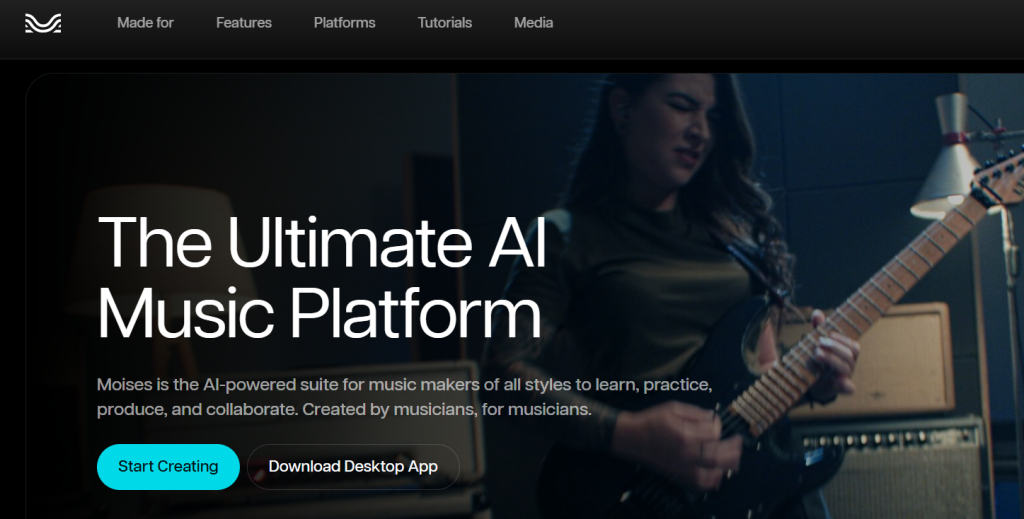
AI-powered music practice and remixing app
What it is: Moises uses advanced source separation algorithms to remove vocals, isolate instruments, and remix tracks for musicians of all levels.
Standout features:
- Separate vocals, drums, bass, and other stems
- AI-driven tempo and pitch control
- Import from YouTube and other platforms
- Cloud-based song mastering and remixing
Pricing: Free plan; premium tiers available
Best for: Musicians and producers seeking audio separation
Pros: - Extremely accurate AI separation
- Integrates with DAWs and cloud storage
Cons: - Free version limits export options
- Internet connection required for processing
Comparison Table
| Tool | Key Use Case | Starts At | Free Plan | Standout Feature |
| ChordChord | AI chord progression generation | See site | Yes | AI chord player with collaboration |
| Chord Identifier | Automatic chord recognition | $4.99/mo | Trial | PDF chord worksheets |
| ChordCreate | Quick AI chord generator | Free | Yes | Instant progression creation |
| Lamucal | All-in-one music creation & learning | $4.16/mo | No | Chord simplification + vocal remover |
| LANDR | Mastering and distribution suite | $11.99/mo | Yes | AI mastering and release tools |
| Bunder | Collaborative songwriting workspace | See site | Yes | Real-time co-writing with AI |
| Virtuozy Pro | AI creation + distribution | $9.99/mo | No | Unlimited AI music tools |
| Moises | Audio separation and remixing | Free | Yes | YouTube import and remix engine |
How to Choose the Right Chord AI Tool
- For fast chord generation, choose tools like ChordCreate or ChordChord.
- If you need recognition or analysis, Chord Identifier is best suited.
- Lamucal and Moises are ideal for learners and practice-oriented users.
- LANDR and Virtuozy Pro serve producers looking for end-to-end creation and publishing.
- Bunder is perfect for teams writing collaboratively.
- Always check if the tool supports your preferred export formats (MIDI, PDF, or stems).
Why Musicians Are Switching to AI Chord Generators in 2026
Here’s the honest reason: speed without sacrificing creativity.
The best AI tools for musicians don’t replace songwriting, they remove friction.
For beginners, this means less overwhelm.
For professionals, it means faster iteration.
That’s why AI chord progressions are showing up everywhere, from TikTok hooks to Netflix background scores.
Where AI Chord Tools Fit in the Modern Workflow
In a typical AI songwriting workflow 2026, chord AI fits neatly between inspiration and production.
Here’s how creators actually use them:
- Sketch song ideas with a free AI chord generator
- Refine harmony using interactive chord AI
- Export progressions via MIDI chord generator
- Finalize tracks in a DAW with zero theory friction
Some platforms even combine AI songwriting assistants with chord extraction, melody generation, and arrangement tools, making them true AI music co-creation tools.
Beginners vs Pros: Who Benefits More?
Honestly? Both, just in different ways.
For beginners:
- Learn harmony through chord AI apps
- Use AI chord tools for beginners to avoid theory overload
- Instantly hear what “works” musically
For professionals:
- Explore complex jazz or cinematic harmony
- Speed up composition with harmonic AI generators
- Test multiple chord paths without re-recording
That’s why searches like “best AI chord generator for songwriters 2026” are exploding right now.
The Bigger Picture: AI Isn’t Killing Creativity — It’s Unlocking It
There’s a myth that AI music tools make songs sound robotic.
In reality, the opposite is happening.
By offloading technical decisions to AI chord generation, musicians are spending more time on:
- Lyrics
- Emotion
- Arrangement
- Performance
AI handles the structure. Humans handle the soul.
And in 2026, that balance feels just right.
Related Reads
- Top 10 AI Music Generator Tools: Your Guide to AI-Driven Beats
- Top 10 AI Audio Editing Tools to Enhance Your Sound
Final Thoughts: Should You Use Chord AI Tools?
If you’re still manually hunting for chords every time inspiration strikes, you’re playing the game on hard mode.
Chord AI tools are redefining modern songwriting and music education by turning complex theory into intuitive, creative workflows.
Whether you’re building progressions for a new track, analyzing existing songs, or co-writing remotely, these platforms empower you to create faster and smarter.
The best chord AI tools 2026 aren’t shortcuts, they’re creative amplifiers.
Whether you’re building beats, writing guitar songs, scoring films, or experimenting with new sounds, AI chord generators give you momentum.
And momentum, in music, is everything.
Explore the tools listed above to discover how AI can elevate your music composition and production process in 2026.
FAQs
What is a Chord AI Tool?
A Chord AI tool is software that uses artificial intelligence to generate, identify, or suggest chord progressions and harmonies based on genre or emotion.
Is AI-generated music suitable for production?
Yes. Many modern AI tools produce high-quality, royalty-free results used by independent artists and producers for professional projects.
Are there free Chord AI tools?
Yes. Platforms like ChordCreate and Moises offer free access with limited features, suitable for quick songwriting or practice.
How should I choose the right one?
Decide whether you want chord recognition, creation, or full production tools. Then compare based on features like collaboration, export formats, and device compatibility.
Do AI chord tools replace music theory?
They don’t replace theory but make it more approachable. These tools help visualize concepts while keeping creativity central.
Can I export my chords for use in DAWs?
Yes. Most AI chord tools allow exports in MIDI or sheet format, compatible with popular DAWs like Ableton Live, Logic Pro, and FL Studio.