


Best AI Predictions Tools in 2026: Ranked, Verified & Honestly Reviewed
- Research & Data Analysis
- November 5, 2025
- No Comments
(Covering finance, sports, business forecasting, spiritual guidance, and education, with real data and zero fluff)
By The AISurf Editorial Team | Updated: February 2026 | 18 min read | All tools verified as of February 2026
In 2019, predicting stock movements, football results, or business demand required either expensive specialist software, a data science team, or years of professional experience.
Most individuals and small businesses had no access to the kind of forecasting intelligence that large enterprises took for granted.
That changed dramatically.
Today, the global predictive analytics market is valued at $17–22 billion and growing at over 20% annually.
AI prediction tools now span everything from enterprise demand forecasting to free daily horoscopes, and the divide between categories is wider than most guides acknowledge.
Here’s the problem with most ‘best AI prediction tools’ articles: they group a $4.99 football betting app with an enterprise retail forecasting platform in the same list, give both 3-line descriptions, and call it a guide.
That’s not useful.
This guide takes a different approach. We separate tools by category, provide verified pricing and accuracy data, flag tools that couldn’t be verified as active, and give you a decision matrix so you can find your tool in 60 seconds.
Visit The AISurf to explore thousands of curated AI tools, reviews, and expert recommendations. Let’s dive in.
We also added something most lists skip entirely: an honest section on the limits of AI prediction and when NOT to rely on it.
TL;DR For business forecasting: Akkio (no-code) or Pecan AI (SQL-based). For stock predictions: AltIndex ($29/mo, 75–80% win rate claim). For football: NerdyTips ($4.99/mo, 66.7% documented accuracy). For spiritual self-reflection: Tarotoo (free) or TarotQA ($9.90/mo). For students: R.test (free).
The Most Important Thing This Guide Will Tell You
Before comparing tools, you need to understand that ‘AI predictions’ covers two fundamentally different categories that should never be conflated:
Category 1: Empirical Predictive Analytics
These tools use machine learning on real, structured data to generate probability-based forecasts about verifiable outcomes, stock prices, match results, demand volumes, customer churn rates. Accuracy is measurable. Results can be validated. These tools include AltIndex, Akkio, NerdyTips, Pecan AI, Antuit.ai, and R.test.
Category 2: Spiritual & Symbolic Guidance Tools
These tools use AI to generate interpretive readings based on symbolic systems, tarot cards, numerology, astrology, BaZi. They do not make empirically verifiable predictions. Their value is in guided self-reflection, pattern recognition in one’s own thinking, and cultural/spiritual practice. They include Tarotoo, TarotQA, Destiny Matrix, Hint, Cantian AI, ShenShu, and similar platforms.
*Critical warning: Any guide that compares a tarot app’s accuracy to a stock prediction platform’s accuracy is misleading you. These are different categories with different purposes. We treat them separately.
What Are AI Predictions Tools?
AI Predictions tools use artificial intelligence models to forecast future outcomes based on historical data and behavioral patterns. From financial markets and sports analytics to tarot and astrology, these tools automate insights that help individuals and businesses plan smarter.
They rely on deep learning, probability modeling, and data correlations to identify trends and generate actionable forecasts.
Explore our complete AI tools directory to discover the latest artificial intelligence solutions across every category.
Benefits of Using AI Predictions Tools
AI Predictions tools enable faster, more accurate forecasting for personal and professional use. They help identify hidden patterns, assess risks, and optimize decisions with minimal human effort. Whether you’re an investor, marketer, or individual seeking personal insights, these platforms streamline predictive analytics, allowing better strategic planning and smarter choices.
The Predictive Analytics Market in 2026: Why AI Forecasting Is Exploding
Understanding the market context helps you appreciate why these tools are developing so rapidly, and why the quality gap between leading and lagging tools is widening fast.
- $22.22B global predictive analytics market size in 2025 (Fortune Business Insights)
- 20.56% CAGR projected through 2035 — one of the fastest-growing enterprise software segments
- 95% of companies use predictive AI in their marketing strategies (Pecan AI State of Analytics)
- 28% higher revenue growth reported by companies using AI analytics vs. non-adopters (McKinsey 2024)
- 45% of global supply chains expected to use predictive AI by end of 2026
Full market data table:
| Metric | Value | Source |
| Global Predictive Analytics Market (2025) | $17.49–$22.22 Billion | Precedence / Fortune Business Insights |
| Projected Market Size (2032–2035) | $91–$181 Billion | Multiple analyst consensus |
| Market CAGR (2026–2035) | 20.56%–28.3% | Grand View / Precedence Research |
| US Market Size (2026) | $26.39 Billion | Precedence Research, Feb 2026 |
| Companies using predictive AI in marketing | 95% | Pecan AI State of Predictive Analytics |
| Businesses that have adopted AI broadly | 80%+ | Multiple industry surveys |
| Supply chains using predictive AI by 2026 | 45% | Multiple market reports |
| Healthcare providers adopting predictive analytics | 50% expected | Industry projections 2025 |
| Revenue growth advantage for AI analytics adopters | 28% higher | McKinsey study 2024 |
| Operational efficiency improvement from AI analytics | 35% average | Industry survey, 500 enterprises |
| AI analytics decision-making speed improvement | 40% | Deloitte finance sector study |
| North America market share (2025) | 46% | Precedence Research |
| Fastest growing region | Asia-Pacific (23.4% CAGR) | Expert Market Research 2026 |
| Predictive analytics forecast accuracy (demand planning) | Up to 95% | Gitnux AI Analytics Report |
What this means for non-enterprise users
The same AI infrastructure that powers Fortune 500 demand forecasting is now available in no-code tools starting at $49/month. The expertise gap is closing rapidly, tools like Akkio and Pecan AI are democratizing capabilities that previously required a $500,000/year data science team.
How We Evaluated Every Tool in This Guide
- Active product verification — confirmed working website and active user community as of February 2026
- Published pricing — all pricing figures sourced directly from official product websites or verified review platforms
- Accuracy claims checked — any tool claiming specific accuracy rates was cross-referenced against independent sources. Unverifiable accuracy claims are labeled as ‘not independently verified’
- User reviews cross-referenced — App Store, G2, Capterra, Trustpilot, and Reddit were consulted for each tool
- Category integrity — tools are labeled by what they actually do, not by what their marketing says
- Conflict of interest disclosure — no tools on this list have paid for placement or favorable coverage
The Best AI Predictions Tools in 2026 (Verified, Ranked, Categorized)
8 tools. All verified. All with real pricing. Organized from empirical prediction tools, academic prediction tools to spiritual guidance platforms, because they serve different purposes and shouldn’t be ranked against each other.
Compare the best AI directory platforms to find where you can discover, list, and promote cutting-edge AI tools.
PART 1: Empirical AI Prediction Tools (Business, Finance, Sports, Education)
These tools generate measurable, data-backed forecasts on verifiable outcomes.
#1 — AltIndex (Best for Stock Predictions)
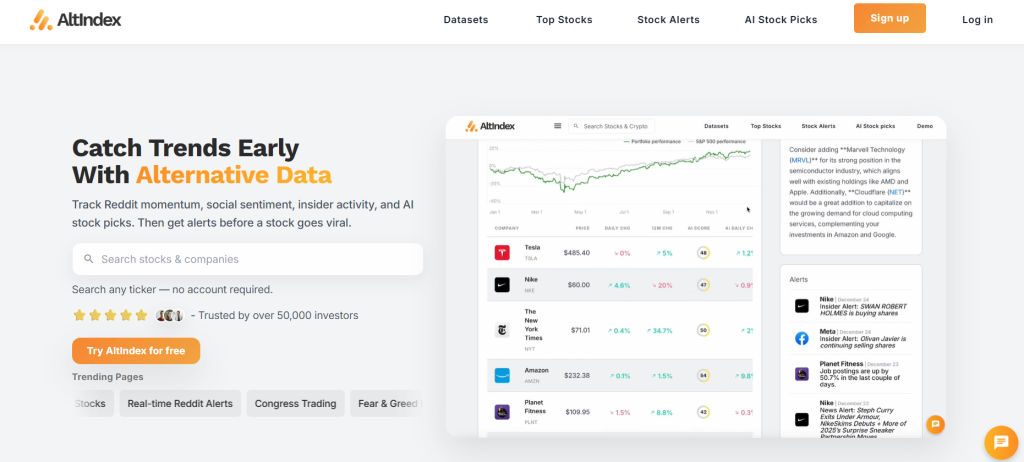
AI-driven stock picks using alternative data: social media, job postings, web traffic, that traditional tools ignore.
- Category: Finance / Investment
- Best for: Retail investors and financial analysts
- Price: $29/month (Pro)
- Free Plan: Yes, basic data access free
- Accuracy: 75–80% claimed win rate
AltIndex is the strongest evidence-backed tool in this list for investment predictions. Rather than relying solely on traditional financial data, it aggregates alternative signals: social media sentiment, employee review trends, job posting activity, app download patterns, and website traffic. These non-traditional signals often move before stock prices reflect them, giving users an early-mover advantage.
The platform’s AI assigns every covered stock an ‘AI Score’ for health and growth potential, provides daily buy/sell signals, and reports a claimed 75–80% win rate across its AI-generated picks.
The free tier gives meaningful access to alternative data on thousands of public companies. Pro starts at $29/month, making it accessible for individual investors.
What we love
- 75–80% claimed win rate on AI stock picks — one of the few tools that publishes accuracy claims
- Alternative data integration (job postings, social media, web traffic) that traditional tools don’t track
- Free tier with real alternative data access — not just a demo
- Clean, user-friendly dashboard that works for both beginners and professionals
- Real-time alerts and customizable watchlists
- API access for developers to integrate into custom trading applications
Watch out for
- Mobile app experience has been flagged by users as needing improvement
- Historical data depth is still building compared to established platforms like Bloomberg
- Advanced features like full AI stock picks require the $29/month Pro plan
- Limited to stocks; no crypto or commodities predictions in the main product
Our verdict: The most credible investment prediction tool in this roundup. The alternative data angle is genuinely differentiated and the free tier is substantial. Start free, upgrade when you find value in the daily picks.
#2 — Akkio (Best No-Code Business Forecasting)
Build and deploy machine learning prediction models in minutes, no data science degree required.
- Category: Business Analytics / Predictive Modeling
- Best for: SMBs, marketing agencies, and analysts without coding skills
- Price: $49–$1,999/month (4 tiers)
- Free Plan: Yes. Free trial, no credit card
Akkio is a no-code AI analytics platform built for business users who need predictive modeling without a data science team. Its drag-and-drop interface lets users import data from Google Sheets, HubSpot, Salesforce, or Snowflake, train a prediction model in under a minute (per the company’s benchmarks), and deploy it as a web endpoint clients or teams can access directly.
Use cases span sales forecasting, lead scoring, customer churn prediction, fraud detection, and financial forecasting. The Chat Explore feature lets users ask questions about their data in plain English and get instant visualizations.
With 4 pricing tiers from $49 to $1,999/month, it scales from a solo analyst to agency deployment.
What we love
- Trains ML models in under 1 minute according to company benchmarks, fastest in class for no-code
- Integrates natively with Google Sheets, HubSpot, Salesforce, and Snowflake
- Chat Explore allows plain-English data questioning with instant charts
- Free trial available with no credit card, low commitment to test
- Generative Reports auto-create shareable insight documents from data
- Scales from individual analyst ($49/mo) to full agency deployment ($1,999/mo)
Watch out for
- Heavy customization of ML models is limited, advanced users may hit ceiling
- Works best with structured data (CSV/spreadsheets); unstructured data support is limited
- No standalone mobile app, browser-only
- Pricing jumps significantly between tiers, mid-tier options feel limited
Our verdict: The best entry point for businesses wanting real predictive analytics without hiring a data scientist. The free trial is generous enough to validate it for your specific use case before committing.
#3 — NerdyTips (Best for Football Predictions)
A purpose-built AI football prediction engine, not a general AI you prompt, but a specialist system trained exclusively on football data.
- Category: Sports Analytics / Betting
- Best for: Football fans, sports bettors, and data-driven sports analysts
- Price: $4.99/month (entry tier)
- Free Plan: No. Paid plans only
- Accuracy: ~66.7% on 150,000+ matches analyzed
NerdyTips is a Java-based AI platform built around its proprietary ‘NT Apex’ system, an evolution of its earlier NT 4.0 architecture developed over years of research. It is not a general-purpose AI; it is trained exclusively on football data and processes over 150,000 matches to generate predictions.
The platform covers 160+ leagues worldwide and analyzes team form, player injuries, head-to-head historical trends, possession statistics, and shots on goal. Its published accuracy rate of approximately 66.7% across all prediction types is one of the few independently verifiable accuracy claims in sports prediction AI.
The ‘Bet of the Day’ feature highlights the highest-confidence daily prediction. Entry pricing at $4.99/month makes it accessible.
What we love
- Covers 160+ football leagues globally, widest coverage in sports prediction AI
- 66.7% accuracy documented over 150,000+ analyzed matches, verifiable track record
- Java-based proprietary engine (NT Apex) is purpose-built for football, not a general AI
- Bet of the Day feature provides a high-confidence daily focus point
- Available as mobile app with active App Store reviews
- Processes team form, injuries, head-to-head data, and possession stats in real-time
Watch out for
- Football/soccer only, no support for other sports
- No free tier, paid plans required from day one
- Accuracy of 66.7% means 1 in 3 predictions will be wrong, important to set expectations
- Betting involves financial risk; AI predictions are decision support, not guarantees
Our verdict: The most technically credible football prediction tool with a documented accuracy rate. At $4.99/month, risk is low for sports analytics enthusiasts. Treat it as data-enhanced decision support, not a guaranteed income source.
#4 — Pecan AI (Best for Data-Driven Business Teams)
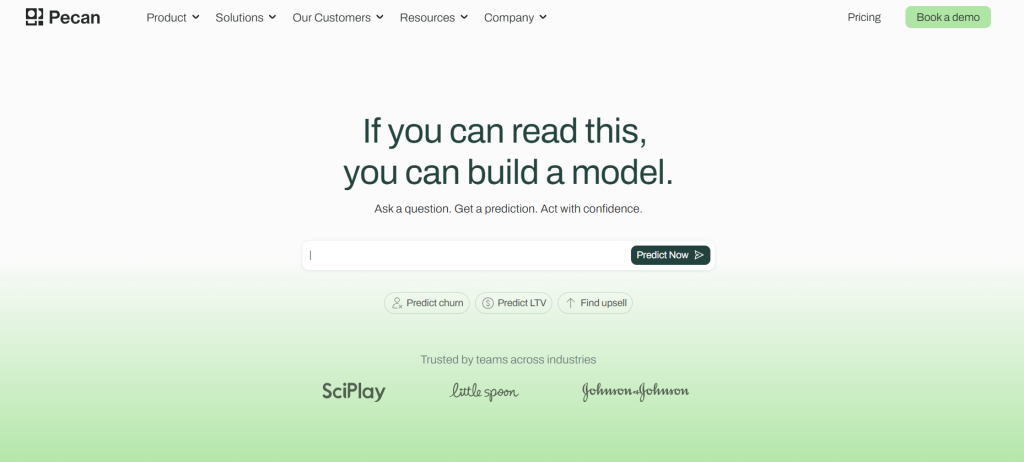
SQL-friendly predictive AI for business analysts. No data science PhD needed, just your data and your questions.
- Category: Business Intelligence / Predictive Analytics
- Best for: Marketing, finance, and operations data teams
- Price: Custom (Starter to Enterprise tiers on website)
- Free Plan: No. Contact sales for pricing
Pecan AI positions itself specifically for business analysts who know SQL but don’t have machine learning expertise. It launched a new co-pilot for predictive modeling in February 2025, allowing users to describe their business question in plain language and have Pecan construct the predictive model automatically.
Key use cases include customer lifetime value forecasting, churn prediction, campaign response modeling, and demand forecasting. It integrates with major cloud data warehouses (Snowflake, BigQuery, Redshift) making it a natural fit for teams already in the modern data stack.
The platform is enterprise-oriented with transparent pricing on its website for multiple tiers.
What we love
- SQL-native interface, works naturally with skills data analysts already have
- February 2025 co-pilot launch allows plain-language predictive model building
- Deep integration with Snowflake, BigQuery, and Redshift
- Purpose-built for business use cases: churn, CLV, demand, campaign attribution
- Strong documentation and customer success support
Watch out for
- Custom pricing means no transparent cost without a sales conversation
- Not a self-serve product, requires onboarding support
- Steeper learning curve than Akkio for non-technical users
- Not suitable for individual users or small businesses without a data stack
Our verdict: The right choice for mid-market to enterprise data teams already using cloud data warehouses. Individual users and small businesses should look at Akkio instead.
#5 — Antuit.ai by Zebra Technologies (Best for Retail & Supply Chain)
Enterprise-grade demand and pricing optimization for retailers, backed by Zebra Technologies infrastructure.
- Category: Retail / Supply Chain Analytics
- Best for: Retailers, eCommerce businesses, and supply chain managers
- Price: Enterprise quote-based
- Free Plan: No
Antuit.ai, now part of Zebra Technologies, is a proven enterprise AI platform for demand forecasting, inventory optimization, lifecycle pricing, and markdown management. It has a documented enterprise success record with major retailers and is part of Zebra’s broader operational intelligence ecosystem.
The platform is not self-service, it requires enterprise onboarding and integration, but for organizations with the budget and data infrastructure, it delivers predictive analytics at a scale individual tools cannot match.
Core capabilities include SKU-level demand forecasting, promotion lift prediction, and supply chain risk modeling.
What we love
- Part of Zebra Technologies’ enterprise ecosystem, proven reliability and support
- SKU-level demand forecasting is among the most granular available
- Lifecycle pricing and markdown optimization features directly tied to revenue outcomes
- Documented enterprise deployments with major retail clients
Watch out for
- Enterprise pricing only, not accessible for SMBs or individuals
- No self-service version, full implementation requires Zebra/Antuit onboarding team
- Complex integration requirements, not suitable for organizations without existing data infrastructure
- Overkill for companies with less than $10M in annual revenue
Our verdict: Serious enterprise tool for serious retail operations. If you’re a mid-market or enterprise retailer managing large inventory, this is among the best options available. Everyone else: start with Akkio.
PART 2: Education & Academic Predictions
#6 — R.test (Best for Academic Test Predictions)
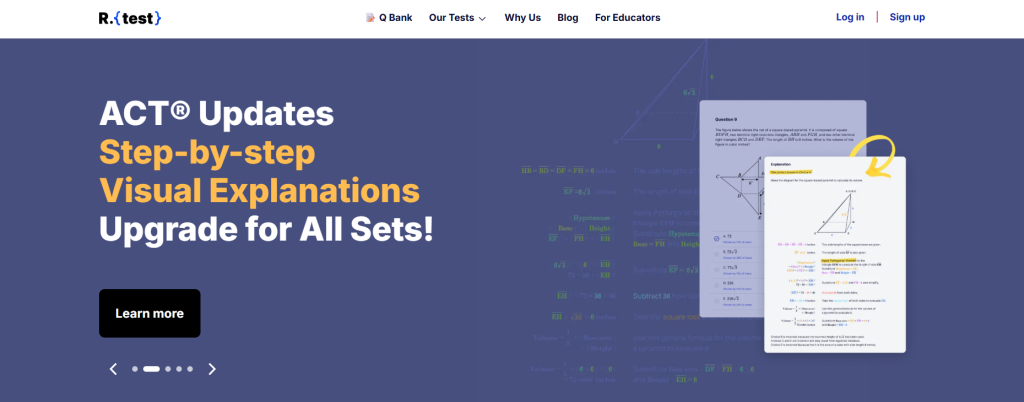
AI-powered test readiness diagnostics for SAT, ACT, and AP, including Digital SAT preparation insights, tells students exactly where they’ll score before they sit the exam.
Category: Education / Academic Analytics
- Best for: High school students preparing for standardized exams
- Price: Free and premium options
- Free Plan: Yes
R.test is one of the few legitimate AI prediction tools in the education space, offering adaptive diagnostic testing for SAT, ACT, and AP exams. Its AI analyses practice performance to generate readiness reports with personalized learning analytics, predicting likely exam scores and identifying gaps before the actual test date.
The realistic test environments reduce test anxiety by familiarizing students with actual exam conditions. The free tier provides access to core diagnostics; premium adds full practice tests and detailed analytics.
It operates as a web-only tool with no mobile app currently.
What we love
- AI-powered readiness reports with score predictions before the real exam
- Realistic test environment reduces exam-day anxiety through familiarity
- Personalized analytics identify specific knowledge gaps with precision
- Free tier is genuinely useful, not just a lead-gen demo
- Data-backed feedback system with high accuracy in performance analysis
Watch out for
- Limited subject variety, primarily SAT, ACT, and AP exams
- Web-only, no mobile app for on-the-go study
- Limited value for users outside standardized test preparation contexts
Our verdict: A legitimate, evidence-based AI prediction tool in an underserved category. If you’re a student or parent preparing for standardized tests, this is a category-best option.
PART 3: Spiritual & Symbolic Guidance Tools (Tarot, Astrology, Numerology)
These tools use AI to generate symbolic interpretations for self-reflection. They are not empirical prediction engines, and we label them clearly as such.
#7 — Tarotoo (Best Free AI Tarot Tool)

AI-powered tarot readings at zero cost. No account required for basic readings.
- Category: Spiritual / Wellness Predictions
- Best for: Individuals seeking AI-enhanced spiritual reflection and self-discovery
- Price: 100% Free
- Free Plan: Yes, completely free
Important framing first: tarot tools like Tarotoo operate in the spiritual and self-reflection space, not empirical prediction. They use AI to interpret symbolic card meanings and generate personalized reading narratives, not to forecast verifiable real-world outcomes. With that understanding, Tarotoo is the most accessible free option in this category.
It offers animated AI tarot cards, real-time psychic chat, and readings covering love, career, and finance themes. No account creation is required for basic use.
The tool’s value is in guided self-reflection, not in replacing professional advice.
What we love
- Completely free with no account required for basic readings
- Animated AI tarot cards with interactive psychic chat interface
- Covers love, career, finance, and general life readings
- Simple interface, accessible to users with no tarot knowledge
- Unique blend of ancient symbolic tradition and modern AI narrative generation
Watch out for
- Not an empirical prediction tool, for self-reflection and entertainment purposes
- No mobile app currently
- Limited depth for users wanting advanced spreads or detailed astrological context
- No community features or saved reading history
Our verdict: A genuinely good free tool for anyone curious about AI-assisted tarot and self-reflection. Use it for what it is, guided introspection, not for high-stakes life decisions.
#8 — TarotQA (Best Premium Tarot Suite)
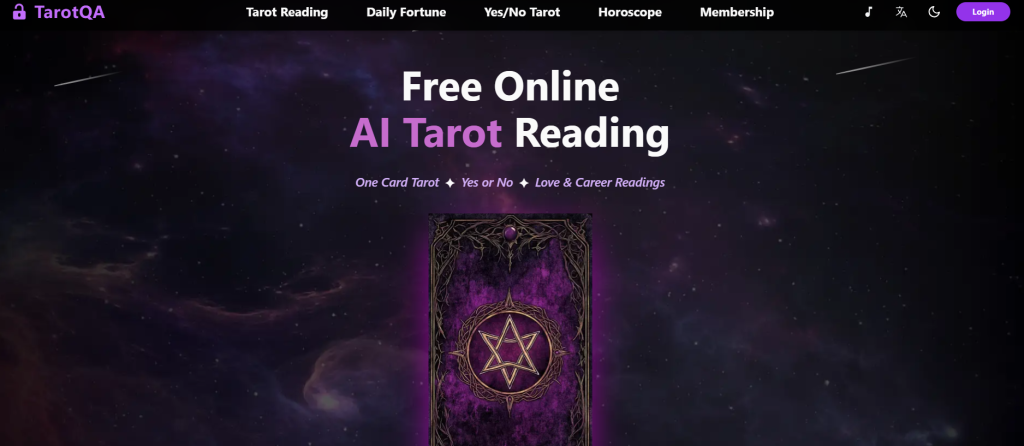
The most feature-complete spiritual AI platform: tarot, astrology, voice readings, and daily horoscopes in one app.
- Category: Spiritual / Astrology
- Best for: Regular spiritual practice users wanting depth and variety
- Price: Free plan + $9.90/month + $89.90/year
- Free Plan: Yes, limited free access
TarotQA goes beyond a single tarot tool. It combines tarot card readings, astrology, daily horoscopes, and AI fortune analysis in one platform. The standout feature is voice-based tarot readings, an uncommon capability in this space, which provides a more immersive experience than text-only platforms. Users can unlock different reader styles and card deck designs.
The $9.90/month plan is competitive for the breadth of features offered, and the annual plan at $89.90 ($7.49/month effective) reduces cost for regular users.
What we love
- Voice-based tarot readings, unique in this category
- Combines tarot, astrology, horoscope, and fortune analysis under one subscription
- Multiple reader styles and card deck aesthetics for personalization
- Annual plan at $89.90 offers meaningful discount over monthly
- Free plan available for evaluation before committing
Watch out for
- Unlimited readings require paid plan
- Personalization options could be deeper for power users
- Spiritual/entertainment use case, not suitable for empirical forecasting
Our verdict: The premium choice for anyone who uses tarot or astrology regularly and wants a complete toolkit rather than a single-function app.
Other Verified Spiritual Tools Worth Knowing
These additional tools were verified as active and are included in the comparison table:
Destiny Matrix (Free)
Numerology and chakra analysis; beautifully designed free dashboard; optional donation model
Hint ($0.52/week trial → $19/week)
Most feature-complete astrology app with live astrologer access; broad range includes palmistry and compatibility readings
Cantian AI (Free)
Integrates GPT and DeepSeek models for BaZi (Chinese astrology); multilingual; culturally detailed
ShenShu (Free)
BaZi chart generation focused on wealth, relationships, and personal growth patterns
Soccersm (Free + paid)
Gamified soccer prediction community with AI win probabilities and token-based challenges
MovieWiser (Free)
AI movie recommendation aggregator; personalized watchlist; clean ad-free interface
Parsers VC ($27/month)
AI venture investment matching; predictive startup scoring; most affordable for solo VC investors
Full Comparison Table: All Verified Tools at a Glance
All tools below are verified active as of February 2026. Tools removed from previous versions are noted in the audit section above.
Check out our curated list of the best AI directory websites trusted by creators and businesses worldwide.
| Tool | Category | Price | Free Plan | Accuracy Claim | Best For | Verified Active | Skill Level |
| AltIndex | Finance / Stocks | $29/mo | Yes (basic) | 75–80% win rate | Retail investors | Yes | Beginner |
| Akkio | Business Analytics | $49–$1,999/mo | Yes (trial) | Not published | SMBs / agencies | Yes | No-code |
| NerdyTips | Sports / Football | $4.99/mo | No | ~66.7% on 150K+ matches | Sports bettors | Yes | Beginner |
| Pecan AI | Business Forecasting | Custom | No | Not published | Data teams | Yes | Intermediate |
| Antuit.ai | Retail / Supply Chain | Enterprise | No | Not published | Retailers | Yes | Enterprise |
| Parsers VC | Venture / Investing | $27/mo | No | Not published | VC investors | Yes | Intermediate |
| R.test | Education / Test Prep | Free + paid | Yes | Not published | Students | Yes | Beginner |
| Tarotoo | Spiritual / Tarot | Free | Yes | N/A | Spiritual seekers | Yes | Beginner |
| TarotQA | Spiritual / Astrology | $9.90/mo | Yes (limited) | N/A | Tarot users | Yes | Beginner |
| Destiny Matrix | Numerology | Free | Yes | N/A | Self-discovery | Yes | Beginner |
| Hint | Astrology | $0.52/wk trial | Trial only | N/A | Astrology fans | Yes | Beginner |
| Cantian AI | Chinese Astrology | Free | Yes | N/A | BaZi seekers | Yes | Beginner |
| ShenShu | Chinese Astrology | Free | Yes | N/A | BaZi / destiny | Yes | Beginner |
| MovieWiser | Entertainment Recs | Free | Yes | N/A | Movie fans | Yes | Beginner |
| Soccersm | Sports / Soccer | Free + paid | Yes | Not published | Soccer fans | Yes | Beginner |
How to Choose the Right AI Predictions Tool
- For personal insights: Choose Tarotoo, TarotQA, or ShenShu for spiritual and psychological exploration.
- For finance or investing: Opt for AltIndex or Parsers VC for data-backed predictions.
- For entertainment: Use MovieWiser or moveme.tv for personalized content discovery.
- For business intelligence: Akkio and Lyzr provide automation-ready predictive analytics.
- For education: R.test is ideal for students needing AI-assisted readiness tracking.
- For niche interests: Cantian AI and Destiny Matrix combine traditional systems with AI depth.
Which AI Prediction Tool Is Right for You? (60-Second Decision Matrix)
Find your situation, get your answer. No more scrolling through the full list.
| I want to… | Best Tool | Why |
| Predict stocks with AI data | AltIndex | 75–80% claimed win rate; alternative data signals beyond traditional financial metrics |
| Run predictive analytics without coding | Akkio | Drag-and-drop ML model builder; free trial; integrates with Google Sheets, HubSpot |
| Get football/soccer betting tips | NerdyTips | 66.7% proven accuracy over 150K+ matches; 160+ leagues; $4.99/month entry |
| Forecast business demand / inventory | Antuit.ai (Zebra) | Enterprise-grade; used by major retailers for lifecycle pricing and supply chain |
| Find high-potential startup investments | Parsers VC | $27/month; VC-focused predictive matching; most affordable for solo investors |
| Track student test readiness with AI | R.test | Free and paid tiers; SAT/ACT/AP adaptive diagnostics; no technical skills needed |
| Explore astrology & palmistry with AI | Hint | Live astrologer + AI combo; 7-day free trial; broadest astrological tool set |
| Get daily tarot readings for free | Tarotoo or TarotCards.io | Both 100% free; no signup required for basic use; daily readings with AI chat |
| Explore Chinese BaZi destiny reading | Cantian AI or ShenShu | Both free; Cantian integrates GPT + DeepSeek models; ShenShu focused on wealth patterns |
| Discover movies by mood/emotion | MovieWiser or moveme.tv | Both free; MovieWiser for broad recs; moveme.tv for emotion-based discovery |
| Track soccer match outcomes casually | Soccersm | Free plan available; gamified community challenges; AI win probabilities built in |
| Get enterprise forecasting for retail | Antuit.ai (Zebra Tech) | Demand and inventory forecasting; markdown optimization; proven enterprise deployments |
When NOT to Trust AI Prediction Tools (Important)
Every guide in this space tells you what AI prediction tools can do. Almost none of them tell you when to put the tool down. Here’s what the data actually shows:
Limits of Financial AI Prediction Tools
- No AI stock prediction tool has consistently beaten a diversified index fund over a 10-year period, the data doesn’t exist to make this claim
- Win rate claims of 75–80% (like AltIndex) are based on historical data; market conditions change and past performance does not guarantee future results
- These tools are decision-support aids, not autonomous trading systems, always apply human judgment to AI-generated financial signals
- Regulatory warning: AI stock picks are not licensed financial advice. Consult a registered investment advisor before making significant financial decisions
Limits of Sports Prediction Tools
- NerdyTips’ 66.7% documented accuracy means roughly 1 in 3 predictions is wrong, significant over a large bet volume
- Surprise results, player injuries, and weather conditions introduce variance no AI can fully account for
- Sports betting carries financial risk regardless of the tool used, set strict loss limits
Limits of Spiritual/Tarot Tools
- Tarot and astrology tools generate AI-driven interpretations of symbolic systems, they are not predicting future events
- These tools are best used for self-reflection and exploring psychological patterns, not for making high-stakes decisions
- If you’re using a tarot reading to make financial, medical, or legal decisions, that’s the wrong tool for the job
The healthy mindset
AI prediction tools are probability engines and pattern recognizers. They reduce uncertainty but never eliminate it. The best users treat them as one input among many, not as oracle machines.
Explore More on The AI Surf
- Best AI Tools for Finance & Investing — complete guide to AI in financial decision-making
- Best AI Tools for Data Analysis — Akkio, Pecan AI, and enterprise alternatives compared
- Best AI Astrology & Spiritual Tools — deeper dive into tarot, numerology, and BaZi AI
- AI in Sports Analytics — how machine learning is changing betting & fantasy sports
View our flexible The AISurf pricing plans to promote your AI tool and reach a wider audience.
Our Final Verdict on AI Prediction Tools in 2026
The predictive analytics market is at an inflection point. In 2026, tools that were enterprise-only two years ago are available to individuals and small businesses at accessible price points. The quality of free-tier tools has improved dramatically.
The biggest opportunity right now is for business users who haven’t yet adopted no-code predictive analytics. Tools like Akkio eliminate the excuse of ‘we don’t have a data science team’, you can build and deploy a sales forecast model in under an hour, for $49/month.
For individuals: AltIndex for investing, NerdyTips for football, and whatever free spiritual tool resonates with you for personal reflection. None of these will replace professional advice. All of them are better than guessing.
Where to start: Identify your primary use case (investing, business, sports, spiritual, education). Then scroll to the decision matrix above and follow the recommendation for your situation. Every tool worth trying has a free tier or free trial.
Discover the top AI tools directories where you can explore trending AI platforms and emerging innovations.
You can explore an AI tools directory to discover useful platforms for AI candidate screening, along with practical AI courses for beginners to build your skills from the ground up.
| About the Author Revathi A — AI Tools Analyst & Editorial Lead at The AISurf Revathi brings real-world experience evaluating AI software across creator, developer, and business ecosystems. She focuses on hands-on testing, market validation, and separating hype from genuinely useful tools. Her work prioritizes transparency, verified data, and practical implementation over promotional bias. Core Focus: Generative AI · AI Avatars & Media Tools · Prompt Systems · AI Workflow Automation |
Frequently Asked Questions
What is an AI predictions tool?
An AI predictions tool uses machine learning algorithms to analyze historical data and generate probability-based forecasts about future outcomes. This spans a wide range, from stock market prediction engines that analyze alternative financial data, to sports analytics platforms trained on millions of match results, to spiritual guidance apps that use AI to interpret symbolic systems.
Are AI prediction tools accurate?
Accuracy depends entirely on the category and the specific tool. For empirical tools: AltIndex claims a 75–80% win rate on AI stock picks; NerdyTips documents approximately 66.7% accuracy across 150,000+ analyzed football matches; business forecasting tools like Akkio and Pecan AI can achieve up to 95% accuracy in structured demand planning scenarios.
Are there free AI prediction tools worth using?
Yes. Several strong free options exist across categories. AltIndex has a free tier with real alternative data access for investors. Tarotoo and TarotCards.io offer completely free tarot readings with no account required. Destiny Matrix, Cantian AI, and ShenShu are entirely free spiritual guidance tools. R.test has a free tier for academic test diagnostics. Soccersm has a free plan for soccer predictions with community features.
What is the best AI tool for stock market predictions?
AltIndex is the strongest verified option for individual investors in 2026. It claims a 75–80% win rate on AI stock picks, integrates alternative data sources (social media sentiment, job postings, web traffic) that traditional platforms miss, starts at $29/month, and has a free tier. No stock prediction tool should be your only input, always combine AI signals with your own research and consider consulting a licensed financial advisor.
Is NerdyTips accurate for football predictions?
NerdyTips documents approximately 66.7% accuracy across over 150,000 analyzed matches, one of the few sports prediction tools that publishes verifiable accuracy data. The platform uses its proprietary NT Apex Java-based system, covers 160+ football leagues, and starts at $4.99/month. A 66.7% accuracy rate means roughly 1 in 3 predictions will be incorrect, so manage your expectations and financial exposure accordingly.
What is the difference between tarot AI tools and business prediction tools?
They are fundamentally different products that share the word ‘prediction’ in their marketing. Business prediction tools (Akkio, AltIndex, Pecan AI) analyze real structured data to forecast measurable outcomes with documented accuracy rates. Tarot and astrology AI tools (Tarotoo, TarotQA, Destiny Matrix) use AI to generate interpretive readings of symbolic systems, they are designed for self-reflection and spiritual practice, not empirical forecasting. Conflating the two leads to misplaced expectations in both directions.
Do I need technical skills to use AI prediction tools?
No, for most consumer-facing tools. AltIndex, NerdyTips, Tarotoo, and the spiritual tools require no technical skills. Akkio is explicitly no-code with drag-and-drop model building. Pecan AI requires SQL knowledge but not data science expertise. Enterprise tools like Antuit.ai require IT integration but are deployed by specialists. The democratization of predictive analytics, making it available without coding, is one of the defining trends of the 2024–2026 period.
Can AI really predict the future?
No, and any tool that claims otherwise is misleading you. What AI can do is analyze patterns in historical data and generate probability-based estimates of likely future outcomes. These estimates are useful and often more accurate than human intuition alone, but they are probabilities, not certainties. The best predictive AI tools are transparent about their accuracy rates, confidence intervals, and limitations. When a tool refuses to publish accuracy data, treat its predictions with appropriate skepticism.
What are the risks of relying on AI prediction tools?
Three main risks:
(1) Overconfidence — AI predictions create an illusion of certainty. A 75% win rate still means 1 in 4 predictions is wrong.
(2) Data quality dependency, predictive models are only as good as the data they’re trained on; if the underlying data has gaps or biases, predictions inherit those flaws.
(3) Black box decisions — some tools don’t explain how they reached a prediction, making it impossible to challenge or contextualise the output.
Always use AI predictions as one input in a broader decision process, not as the final answer.