


B2B Offer Pricing Strategies for Founders in 2025
- B2B
- September 10, 2025
- No Comments
So, you’re a B2B founder staring at your pricing spreadsheet like it’s a cryptic Sudoku puzzle. You know your offer is good. You feel it’s worth the price. But that nagging thought? “What if I’m charging too much… or not enough?”
Here’s the thing: pricing isn’t one-size-fits-all. It’s not just a number — it’s a strategy that should match your offer type, your audience, and your business model.
Let’s walk through five proven B2B offer pricing strategies you can consider right now — without overthinking yourself into a sales slump.
The best B2B offer pricing strategies include:
- High-ticket direct sales via calls.
- Front-end offers to offset CAC.
- Subscription models with price growth.
- Offer ladders with upsells.
- Low-risk front-end launches for feedback.
Choose based on your value, audience, and positioning.
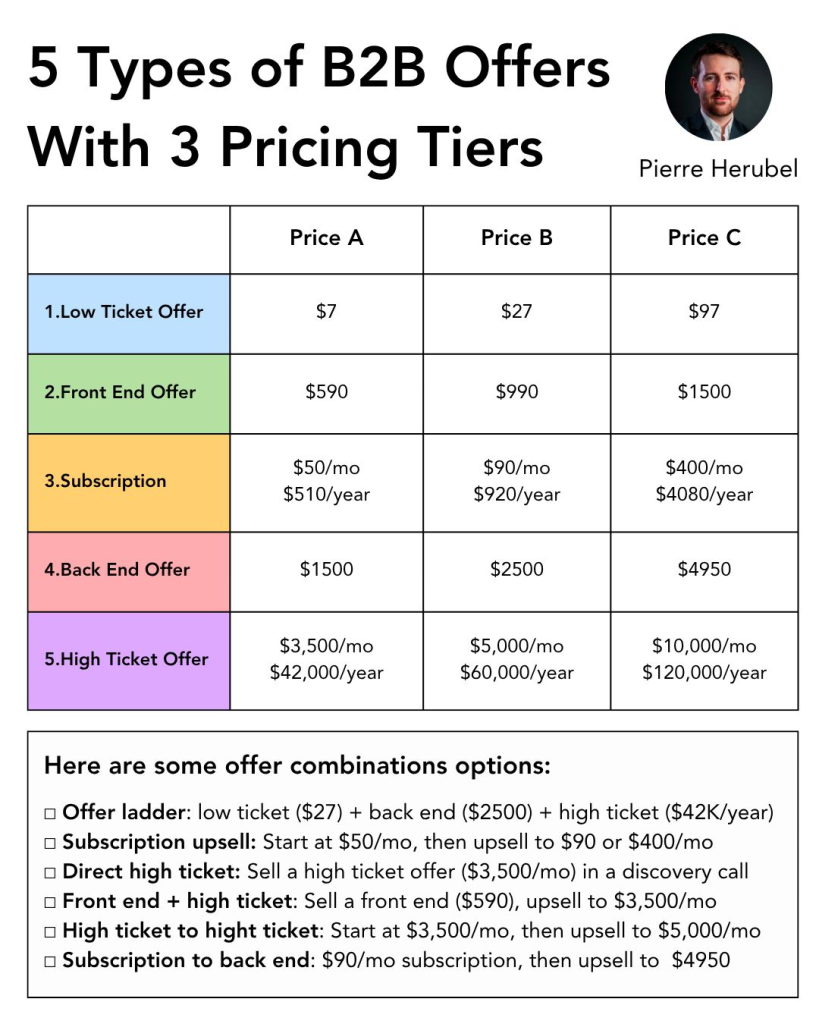
Source: Linkedin User
1. High-Ticket Offer via Discovery Call
Perfect for services and consulting.
Pro tip: Use your call to diagnose before you prescribe. This positions you as a trusted advisor, not just a vendor.
2. Front-End Offer to Cover CAC
This works when your customer acquisition cost (CAC) is eating into margins. You sell a smaller, lower-priced “front-end” offer that covers or reduces CAC — then upsell them into your main, high-ticket offer.
Example: A marketing agency sells a $297 audit that offsets ad spend, then upgrades qualified leads to a $5K/month retainer.
3. Subscription Model with Price Growth
Best for SaaS, memberships, or communities. Start at an entry-level subscription, then gradually increase prices as you add features or value.
Benefits:
- Predictable recurring revenue
- Easier upsells to premium tiers
- Lower upfront decision barrier for customers
According to ProfitWell (2024), SaaS companies with tiered pricing grow 30% faster than flat-rate models.
4. The Offer Ladder
A tiered pathway where customers start low-ticket, then climb toward your high-value backend offers. Works beautifully for courses and coaching.
Example Flow:
- $47 mini-course
- $497 in-depth course
- $5K group coaching
- $20K 1:1 mentorship
You’re essentially warming up cold leads until they’re ready for premium pricing.
5. Low-Risk Launch for Feedback
You’ll get real-world feedback instead of guessing in isolation.
This “beta pricing” approach works across services, SaaS, and info products — plus, early adopters often become your best case studies.
How to Choose the Right Pricing Strategy
No matter which model you pick, match it to:
- Your value proposition (what’s inside your offer)
- Your ideal customer profile (what they can and will pay)
- Your positioning (where you sit in the market)
Remember — pricing is positioning. If you charge like a bargain brand but market like a premium solution, the mismatch will cost you sales.
Suggested Reads:
- AI Market Research Prompt That Actually Works
- SEO in 2025: Beyond Rankings with SEO, AIO, GEO, AEO & SXO
Conclusion
Treat your B2B pricing as a tool for progress, not a matter of luck. A strategic approach—be it a high-cost offering, a subscription model, or a tiered system—can increase your profit margins and improve your client relationships.
The next step is to select a model and put it to the test for 30 days. Then, explore more AI-powered sales and marketing tools at TheAISurf.com.
FAQs
Q1: How often should I adjust my B2B pricing?
Review at least annually, or when your value, costs, or market conditions change significantly.
Q2: What’s the safest way to test new pricing?
Run limited-time offers to a segment of your audience and compare conversion + churn rates before rolling out to everyone.
Q3: Can I combine these strategies?
Absolutely — many founders blend models (e.g., front-end offer + subscription) for maximum revenue and retention.