


The Ultimate Blog Post Structure for SEO & Engagement
- SEO
- October 1, 2025
- No Comments
Ever wonder why some blog posts blow up on Google while others sink into the internet abyss? Spoiler: it’s not just the writing.
A high-ranking, share-worthy blog post is like a well-built house—it needs strong foundations (SEO), good design (structure), and welcoming vibes (engagement hooks). If even one of these is off, readers bounce faster than you can say “back button.”
In this guide, I’ll break down the ultimate blog post structure—the same one used by top-ranking sites—to help you boost both SEO and reader engagement.
What’s the Best Blog Post Structure?
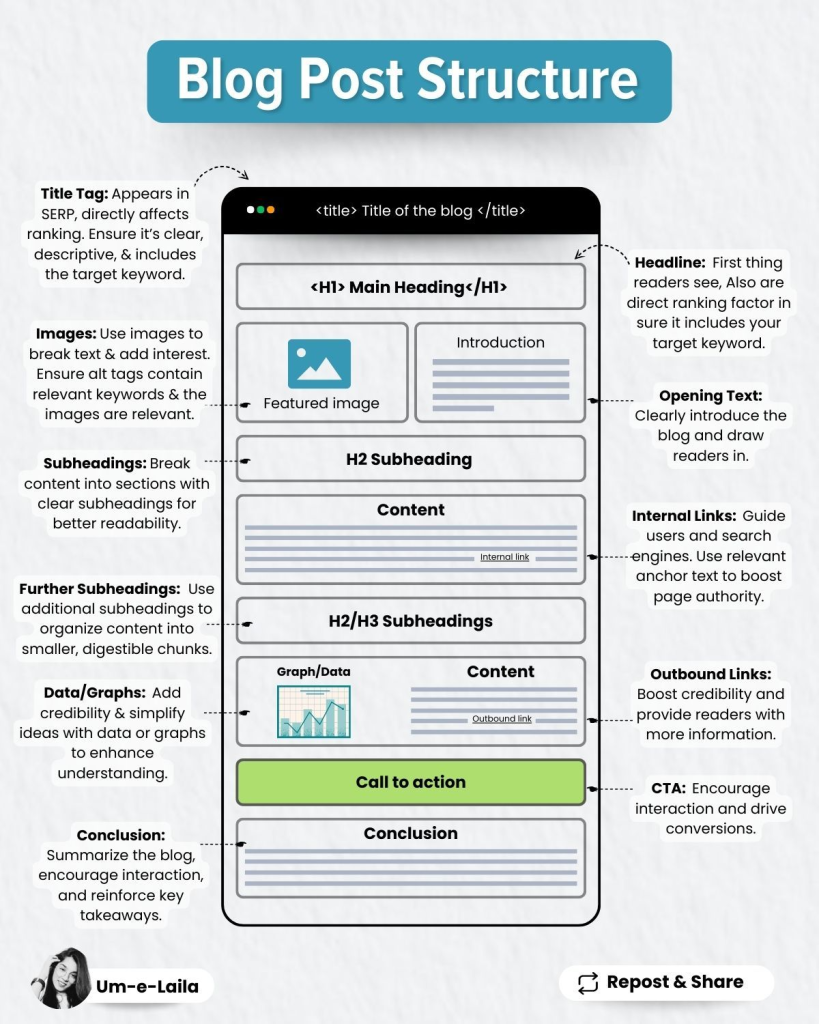
The best blog post structure includes a keyword-rich title tag, engaging headline, compelling introduction, featured image, clear H2–H4 subheadings, supporting data/visuals, and strategic internal links. This setup makes posts easier to read, improves SEO rankings, and keeps readers engaged from start to finish.
1. Title Tag: Your First SEO Win
Your title tag is what people see on Google. It’s a ranking factor and a first impression.
- Appears in search results (big visibility booster).
- Tell readers what your blog delivers.
- Must include your primary keyword (but keep it natural).
Pro tip: Keep it under 60 characters so it doesn’t get cut off in SERPs.
2. Headlines That Hook Readers
Your headline is the “billboard” of your content. If it’s boring, nobody clicks.
What works:
- Immediate attention grabber (numbers, questions, bold promises).
- Includes your main keyword.
- Creates curiosity (but avoids clickbait).
Example: “10 Blog Post Structures That Boost SEO (and Engagement)” → clear + keyword-rich + intriguing.
3. The Introduction: Nail the First 100 Words
Think of the intro as your handshake with the reader.
In the first few lines:
- Tell readers what they’ll get.
- Address a pain point (e.g., “Struggling to rank?”).
- Set the tone (casual, expert, or playful).
If you don’t hook them here, they won’t scroll further.
4. Featured Image = Scroll Stopper
Your featured image isn’t decoration—it’s a traffic magnet.
Why it matters:
- Makes your blog visually appealing.
- Helps with SEO via alt tags.
- Gets picked up when shared on socials.
Choose something bold, clear, and relevant. No generic stock photo of “a person staring at a laptop.”
5. Subheadings (H2s) = Reader-Friendly SEO
Walls of text scare people. Subheadings save the day. Benefits:
- Make scanning super easy.
- Guide readers through your points.
- Provide extra SEO weight when keywords are included.
Structure tip: Use H2s for major sections, H3s/H4s for finer details.
6. Extra Subheadings (H3/H4) for Depth
For longer blogs (like this one), extra subheadings keep things organized. They:
- Break up intimidating content.
- Let readers jump straight to what they need.
- Improve featured snippet potential (Google loves lists + structured content).
7. Data & Graphs: Trust Builders
Numbers talk. Visuals persuade. Adding charts, graphs, or even a single statistic with a source can:
- Simplify tough ideas.
- Add instant credibility.
- Keep people scrolling longer.
(Example: HubSpot found in 2024 that blogs with visuals get 94% more views.)
Recommended Read:
90-Day SEO Blueprint for Fast Growth
Ultimate Technical SEO Cheat Sheet: 10 Steps You MUST Know
Conclusion: Build Posts That Rank and Engage
A blog post is more than words—it’s a framework designed for SEO and engagement. When you nail your title tag, intro, visuals, subheadings, data, and links, you create content that both Google and readers love.
Ready to level up? Explore more AI-powered strategies and tools at TheAISurf.
FAQs: Blog Post Structure & SEO
1. What’s the ideal length for a blog post in 2025?
Most high-ranking blogs range between 1,500–2,500 words (HubSpot, 2024). That said, quality beats length—write enough to cover the topic fully.
2. Do images really affect SEO?
Yes. Optimized images with alt text can drive search traffic, improve engagement, and boost rankings (Search Engine Journal, 2024).
3. How many internal links should I use per post?
Aim for 3–5 natural internal links. Overstuffing feels spammy; underusing leaves SEO power on the table.