


How to Build Backlinks: The Ultimate Guide
- SEO
- September 10, 2025
- No Comments
If you’ve been “doing SEO” for months but your rankings still look like a flatline on life support, here’s the truth: you probably need better backlinks.
Not more spammy ones. Not a thousand forum profiles. Better.
Backlinks are still one of Google’s top ranking signals in 2025, but the game has shifted—quality crushes quantity. And the best part? You don’t need to buy shady packages or beg strangers for links.
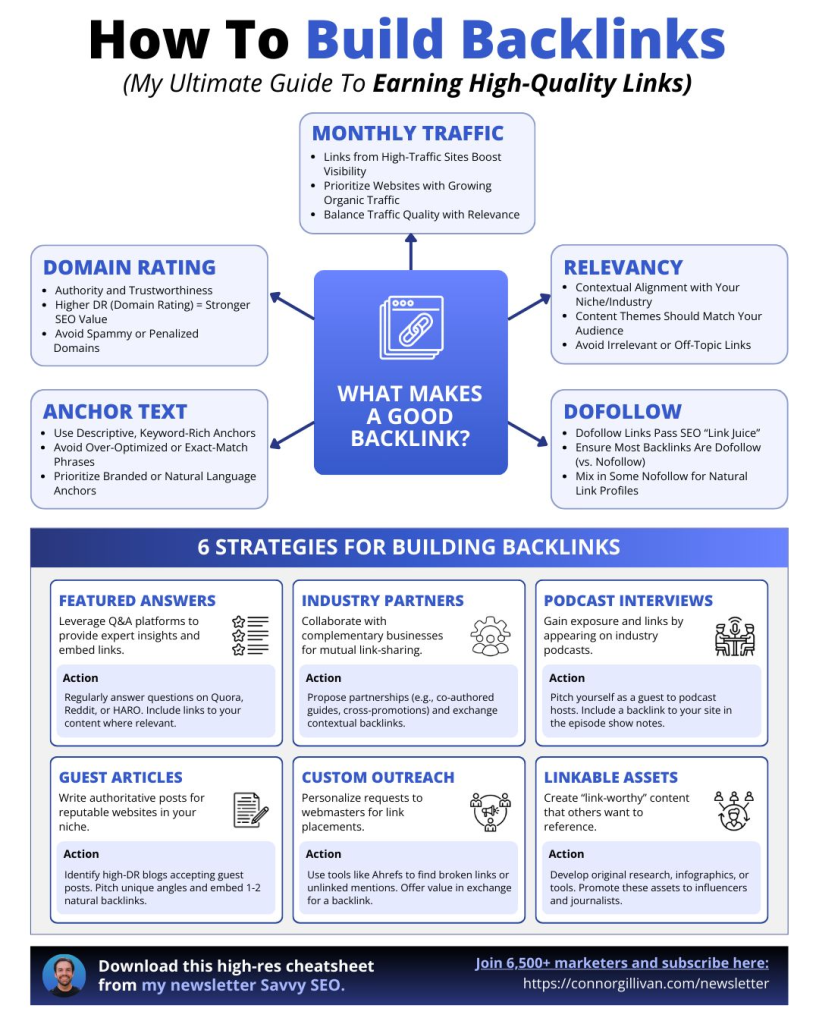
5 Qualities of a High-Quality Backlink
1. Monthly Traffic
Links from high-traffic sites boost visibility. Prioritize websites with growing organic traffic—they’ll keep sending visitors over time. Balance traffic quality with relevance to your niche.
2. Domain Rating (DR)
High DR means authority and trustworthiness. The higher the DR, the stronger the SEO value. Avoid spammy or penalized domains—they’ll drag you down faster than you think.
3. Relevance
Backlinks work best when the linking site’s content themes match your audience. Contextual alignment beats random mentions every time.
4. Anchor Text
Use descriptive, keyword-rich anchors that feel natural. Avoid over-optimized or exact-match spam. Branded and conversational anchors are safer long-term.
5. Dofollow Status
Dofollow links pass SEO “link juice”. Most of your backlinks should be dofollow, but mix in some nofollows for a natural link profile.
6 Proven Strategies for Building Backlinks
1. Featured Answers
Participate in discussions on platforms like HARO by typically offering your expertise. When relevant, you can use your content as a source to provide more details in general.
Action: Regularly answer niche-specific questions and embed links where they genuinely help.
2. Industry Partners
Partner with companies that offer different but related products or services to swap website links.
Action: Co-author guides, do cross-promotions, and exchange contextual backlinks.
3. Podcast Interviews
Guest appearances on niche podcasts = backlinks in show notes.
Action: Pitch yourself to podcast hosts with clear value for their audience.
4. Guest Articles
Write authoritative guest posts for high-DR sites in your niche.
Action: Identify blogs that accept contributions, pitch unique topics, and aim for 1–2 natural backlinks in each post.
5. Custom Outreach
Personalize every pitch to webmasters for link placements.
Action: Use tools like Ahrefs to find broken links or unlinked mentions, then offer value in exchange.
6. Linkable Assets
Create content others can’t resist linking to—think original research, infographics, or free tools.
Action: Share these assets with influencers and journalists.
Suggested Reads:
- Build a Content Engine That Never Sleeps with AI
- AI Infographic Generator: Turn Ideas into Visuals in Seconds
Conclusion
Stop thinking of backlinks as a way to manipulate search engines in general. Instead, view them as a way to prove your credibility and also attract your ideal audience.
Embrace those five qualities and six proven strategies, and you’ll find your rankings typically getting better and better. Explore more AI tools on TheAISurf.
FAQs
Q1: How many backlinks do I need to rank on Google?
It depends on your niche competition. Some pages rank with 10–20 strong backlinks; others need hundreds. Focus on quality first, I would suggest.
Q2: Are backlinks still important for SEO in 2025?
Yes. Based on research conducted by Ahrefs in 2024, there is a clear link between a large number of backlinks and achieving a top search engine ranking. Still, the study found that the quality and authority of the links carry more weight than the total count.
Q3: Should I buy backlinks?
The act of buying links typically goes against Google’s rules and could lead to penalties in general. A more effective strategy involves dedicating resources to producing valuable content.