


LLM Research Prompt: Replace Your Research Team
- AI
- September 10, 2025
- No Comments
AI just killed the research department. Say what you want — but the tools are here. If you pay people $3–6K/month to churn research memos, you can now get a CEO-grade briefing in minutes with the right prompt.
Below is the exact LLM research prompt I use to make any model act like an elite research analyst — plus how to run it, verify results, and avoid the obvious traps.
Use this LLM research prompt to make any large language model perform structured, executive-style research: paste the prompt, insert your topic, ask for 3–5 subtopics, request trends/data/examples, add sources, and finish with a 5-point “Smart Summary.”
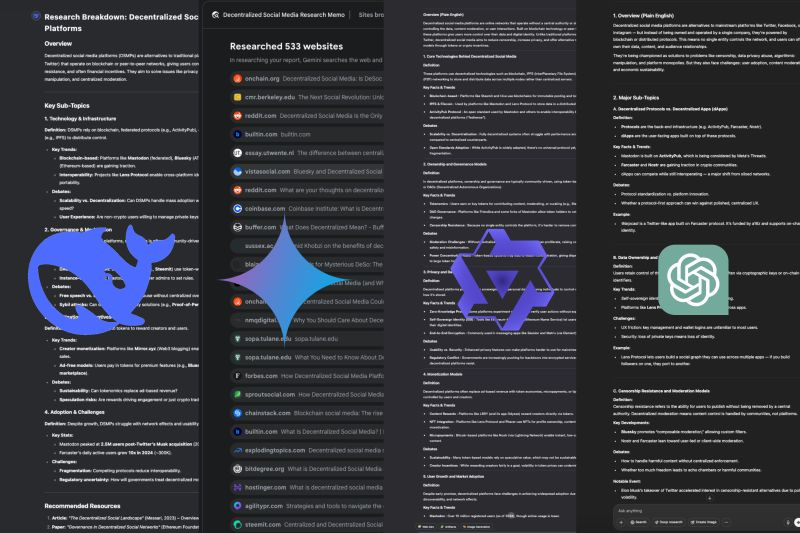
Source: Linkedin User
Why this prompt works
Role framing: telling the model to act like an elite research analyst sets expectations.
- Tight process: step-by-step instructions force structure — overview, components, evidence, resources, summary.
- Skimmable output: CEOs want short, actionable bullets. The prompt designs for that.
This mirrors how modern LLM research features run multi-step internet syntheses in minutes. (OpenAI)
The prompt — copy / paste / run
I want you to act as an elite research analyst with deep experience in synthesizing complex information into clear, concise insights.
Your task is to conduct a comprehensive research breakdown on the following topic:
[ Insert your topic here ]
1. Start with a brief, plain-English overview of the topic.
2. Break the topic into 3–5 major sub-topics or components.
3. For each sub-topic, provide:
– A short definition or explanation
– Key facts, trends, or recent developments
– Any major debates or differing perspectives
4. Include notable data, statistics, or real-world examples where relevant.
5. Recommend 3–5 high-quality resources for further reading (articles, papers, videos, or tools).
6. End with a “Smart Summary”.
Guidelines:
– Write in a clear, structured format
– Prioritize relevance, accuracy, and clarity
– Use formatting (headings, bullets) to make it skimmable and readable
How to run it (practical playbook)
- Paste the prompt into ChatGPT, Gemini, Claude, DeepSeek, Qwen, Mistral — any LLM.
- Insert topic exactly (e.g., “decentralized social media platforms,” “synthetic data governance,” or “2026 adtech trends”).
- Two-pass method:
- Pass 1 — Synthesis: run the prompt and get the memo.
- Pass 2 — Verify: ask the model to “find 5 sources (with links) that support each key fact” and flag anything speculative. Use the model’s function-calling or browsing features where available. (OpenAI)
- Pass 1 — Synthesis: run the prompt and get the memo.
- Cross-check: run the same prompt in a second model (different architecture) and compare contradictions — that’s your quality filter.
Models that scale this well: ChatGPT (with Deep Research / browsing), Elicit for academic literature, and agent frameworks that chain tools.
Example output structure (what you’ll get)
- Overview (2–3 sentences)
- 3–5 subtopics (each: definition, trends, debates)
- Data & examples (year + source when possible)
- 3–5 recommended resources (links)
- Smart Summary (5 bullets) — ready for a board deck
Limitations & guardrails (don’t skip these)
- Hallucinations: LLMs invent citations. Always verify links and dates.
- Bias & perspective: models reflect training data; ask for alternative viewpoints explicitly.
- Depth vs. speed: for frontier academic research you still need domain experts to evaluate methodology. Studies show LLMs assist literature reviews and synthesis well — but not without oversight.
Quick verification checklist
- Do 1–2 manual source checks (open the cited links).
- Ask the model: “Which points are low-confidence? Mark them.”
- Use a specialized tool (Elicit, Semantic Scholar) for academic pulls.
Where this saves money (and where it doesn’t)
- Saves: early scoping, trend spotting, competitive memos, investor one-pagers.
- Not a full replacement: experimental design, lab work, deep peer review, ethical sign-offs — humans still own those.
By 2030, generative AI could automate a notable share of work hours as organizations redesign workflows around AI. This makes LLM research assistants a practical productivity lever, not just a novelty. (McKinsey & Company)
Explore More:
- How to Master LinkedIn in 2025: My Exact Framework
- Full-Stack Marketers + AI: The Future of B2B Marketing
Conclusion
This one LLM research prompt is your fastest lever to turn any large model into a useful research analyst. Use the two-pass method, verify sources, and fold outputs into your workflow. Explore more AI tools on TheAISurf.
FAQs (Google PAA style)
Q: Can an LLM really replace a human researcher?
Not entirely. LLMs excel at scoping, synthesis, and first-draft memos — they’re fast and cheap. But humans must verify sources, judge methodology, and carry ethical responsibility. (arXiv)
Q: Which models should I try first?
Start with ChatGPT (Deep Research / browsing) and a second model like Claude or Gemini for cross-checking. Use Elicit for academic literature pulls. (OpenAI, teach.its.uiowa.edu)
Q: How do I stop the AI from hallucinating citations?
Ask for source links, then manually open 2–3 of them. Use function-calling where available and insist the model flag low-confidence claims.