


19 Prompt Laws for ChatGPT Success
- AI
- September 26, 2025
- No Comments
Most people are using ChatGPT wrong. And I get it—you open the chat, type one vague sentence, and hope magic happens. But here’s the truth: ChatGPT isn’t some all-seeing brain. It’s a mirror. The quality of what you put in determines the clarity of what you get out.
That’s why I built these 19 prompt laws—a simple set of rules to stop getting generic, cookie-cutter outputs and start getting structured, usable results. Think of them as your AI survival guide.
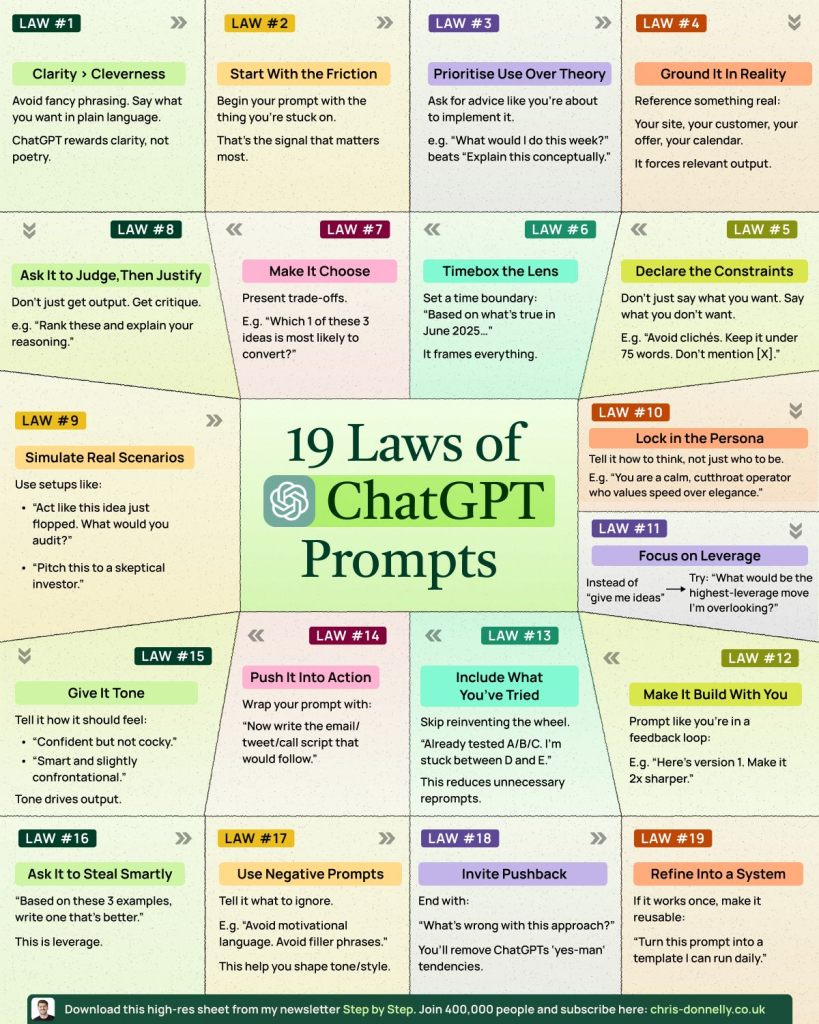
Source: Linkedin User
Why Prompt Laws Matter
If you give ChatGPT a one-liner, you’ll get a one-liner back. If you give it context, constraints, and direction—you’ll get outputs that actually move the needle. In other words: better prompts = better productivity.
The 19 Prompt Laws (With Context)
The 19 prompt laws for ChatGPT are practical rules that help you get clear, structured, and actionable outputs. They cover clarity, constraints, tone, context, feedback loops, and refining into systems. Following them ensures ChatGPT mirrors your intent instead of spitting out generic answers.
Here’s the full list, with short commentary so you can actually use them.
Law #1: Clarity > Cleverness
Plain language wins. Skip the jargon.
Law #2: Start With the Friction
Lead with your pain point—it guides the AI faster.
Law #3: Prioritise Use Over Theory
Ask like you’re about to hit “publish,” not write a dissertation.
Law #4: Ground It in Reality
Anchor it to your product, customer, or scenario.
Law #5: Declare the Constraints
“Give me 500 words, no fluff.” Boom—better output.
Law #6: Timebox the Lens
Limit research to “last 12 months” to avoid outdated junk.
Law #7: Make It Choose
Present trade-offs and let it select. It sharpens the answer.
Law #8: Ask It to Judge, Then Justify
Don’t settle for “Option A.” Ask, “Why A over B?”
Law #9: Simulate Real Scenarios
“Act as my customer support lead on a bad day.” Try it.
Law #10: Lock in the Persona
Tell it how to think (“like a CFO”) not just who to be.
Law #11: Focus on Leverage
Ask for the highest ROI option—not just a list.
Law #12: Make It Build With You
Treat ChatGPT like a collaborator, not a vending machine.
Law #13: Include What You’ve Tried
Sharing past attempts avoids repeated fluff.
Law #14: Push It Into Action
End with: “Now, give me the next three steps.”
Law #15: Give It Tone
Play with tone—casual, direct, funny, sharp. Tone = magic.
Law #16: Ask It to Steal Smartly
Drop in examples and tell it to remix them.
Law #17: Use Negative Prompts
Tell it: “Avoid academic tone. Skip filler.”
Law #18: Invite Pushback
Ask it to disagree or poke holes. Stops echo-chamber results.
Law #19: Refine Into a System
Got a killer prompt? Save it, systemize it, reuse it.
How to Apply These Laws Daily
- Drafting blog posts? Use clarity, tone, and constraints.
- Building marketing campaigns? Lean on scenarios and leverage.
- Automating workflows? Apply systems and pushback.
Common Mistakes People Make With Prompts
Most people treat ChatGPT like Google search. They throw in a short phrase—“write blog intro”—and expect gold. What they get is filler. The mistake isn’t the AI, it’s the setup. Without context, constraints, or tone, you’re leaving the model to guess.
The fix? Slow down. Add detail. Think of prompts as instructions to a freelancer: the clearer you are, the better the work.
Turning Prompt Laws Into Habits
Reading the 19 laws is one thing—using them daily is another. The trick is to turn them into habits. Start small: pick three laws you’ll use in every prompt this week. Maybe “Clarity,” “Constraints,” and “Tone.” Once those feel natural, add more.
Within a month, you’ll notice something wild—your AI outputs won’t just improve, they’ll feel like they were written for you. That’s when you know the laws are working.
Relevant Reads:
Why You Should Use ChatGPT-o3 Instead of GPT-4o
OpenAI Function Calling: o3 & o4-mini Cheat Sheet
Conclusion
ChatGPT isn’t a brain—it’s a mirror. These 19 prompt laws won’t give you strategy, but they’ll ensure you squeeze every drop of value from your AI assistant.
So the next time you open a chat window, skip the vague one-liners. Use these laws, refine them into systems, and watch your productivity skyrocket.
Explore more AI tools on TheAISurf
FAQs
1. Why are my ChatGPT outputs so generic?
Because your prompts are too vague. AI mirrors your input—so if you feed it a one-liner, expect generic results. Adding clarity, tone, and constraints instantly improves responses.
2. What’s the fastest way to improve prompts?
Start with Law #1 (Clarity > Cleverness) and Law #5 (Declare Constraints). These two alone will transform your results within minutes.
3. Can these prompt laws work for tools other than ChatGPT?
Yes. Tools like Claude, Gemini, or even niche AI assistants all follow the same principle: clear input drives valuable output.