


Master the 2025 Search Stack: The 5 Models You Need
- SEO
- September 11, 2025
- No Comments
If you think your marketing will scale with just a great website, rankings, or clicks—sorry, but 2025 called, and it disagrees.
Today, your Search Stack is your real growth engine. It’s the difference between being seen by AI-powered search engines and fading into digital irrelevance.
When every major platform—from Google to ChatGPT—is shaping answers in real time, the way you optimize for search has completely changed. And if even one stage in your stack breaks? The whole machine slows down.
Let’s break down the 5-model Search Stack that’s helping brands stay visible, get cited by AI, and convert attention into revenue.
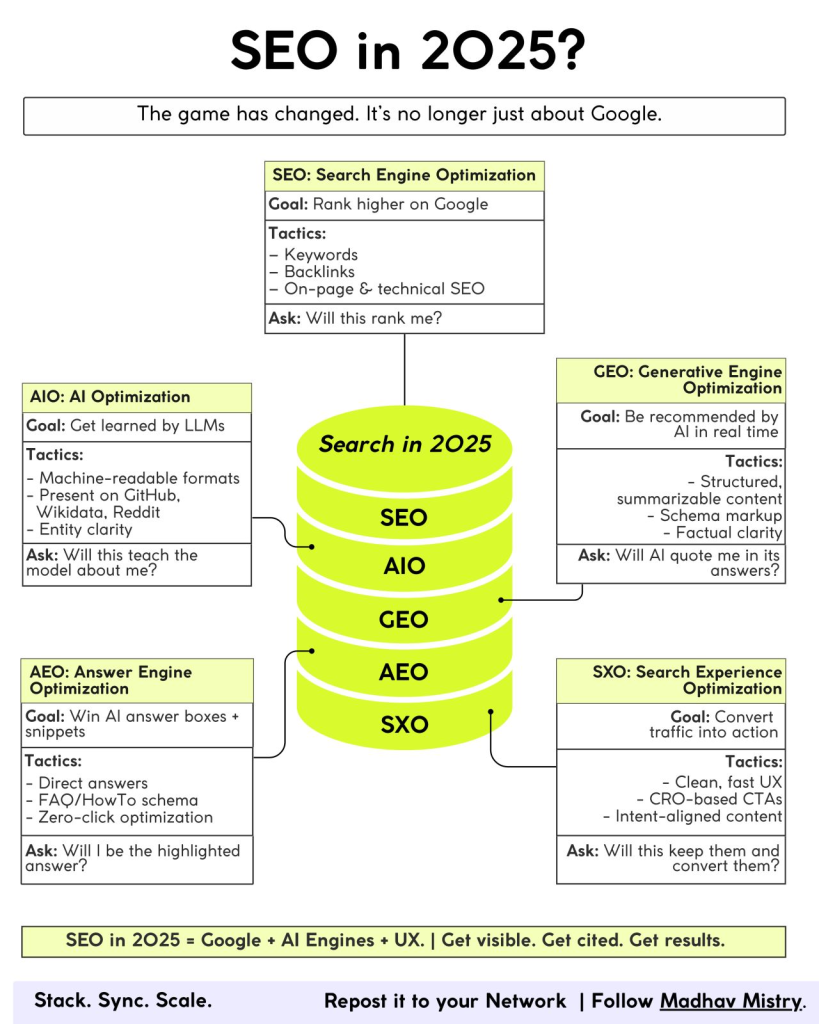
The 2025 Search Stack is a 5-part strategy—SEO, AIO, GEO, AEO, and SXO—that ensures your brand ranks on Google, gets learned by AI models, appears in AI recommendations, wins answer boxes, and converts traffic into action.
Source: Linkedin User
1. SEO — Search Engine Optimization
Goal: Rank higher on Google
Think of SEO as your digital currency. It’s where you:
- Optimize on-page content for keywords
- Build quality backlinks
- Ensure technical SEO is clean
Top tools: Semrush, Google Analytics
Why it matters: Google continues to be the primary portal for billions of online queries. Ignore it, and you lose the largest slice of visibility pie.
2. AIO — AI Optimization
Goal: Get learned by LLMs
This isn’t about just publishing content—it’s about making it machine-readable so Large Language Models (LLMs) can learn from it.
- Publish to trusted, AI-friendly sources like GitHub, Wikidata, Reddit
- Structure data so it’s context-rich for AI models
- Shift from website-first to knowledge-first
Top tools: Jasper, Writesonic, ChatGPT, Surfer SEO
3. GEO — Generative Engine Optimization
Goal: Be recommended by AI in real time
When someone asks ChatGPT, Perplexity, or Bing Chat a question, will they recommend you? That’s GEO’s job.
- Use structured, factual content
- Add Schema.org markup
- Make content summarizable for AI
Top tools: Schema.org, Clearscope, Content Harmony
4. AEO — Answer Engine Optimization
Goal: Win AI answer boxes and featured snippets
This is about being the answer, not just ranking for it.
- Write clear, concise responses
- Add FAQ and HowTo schema
- Use direct, plain-language formatting
Top tools: AlsoAsked, AnswerThePublic, Frase, Semrush
5. SXO — Search Experience Optimization
Goal: Turn traffic into action
Visibility is useless if visitors don’t engage. SXO ensures your site feels effortless to use.
- Fast load times
- CRO-based CTAs
- Clear navigation and mobile-first design
Top tools: Hotjar, Optimizely
Don’t Blame the Engines — Fix the Stack
A weak link anywhere in this chain kills momentum. Your priority: perfect the flow before adding more tools.
- Diagnose the leaky spots
- Patch before scaling
- Keep it tight and intentional
Other Essentials: Brand monitoring (Brand24), design assets (Canva), automation (Zapier, Notion)
Suggested Reads:
- Top Marketing Subreddits to Level Up Your AI & Digital Strategy
- 90-Day Local SEO Checklist to Skyrocket Your Visibility
Conclusion
It’s now about dominating every single step someone takes when they’re looking for something online. True success in an AI-powered world comes from excelling at SEO, AIO, GEO, AEO, and SXO to secure a visible, trusted, and profitable position.
Explore more AI tools on TheAISurf and start building a search strategy that scales.
FAQs
Q1: What is the 2025 Search Stack?
The 2025 Search Stack is a 5-part framework—SEO, AIO, GEO, AEO, SXO—that ensures visibility on Google, AI engines, and answer boxes while improving conversion rates.
Q2: Why is AIO important in 2025?
AI Optimization ensures your content is learned by LLMs like ChatGPT so you appear in AI-generated answers and recommendations.
Q3: How is GEO different from SEO?
Basically, SEO is all about getting noticed on search engines like Google. On the other hand, GEO is for those newer AI tools that give you recommendations right away.